Episode 3 · Duration: 15:41
About this episode
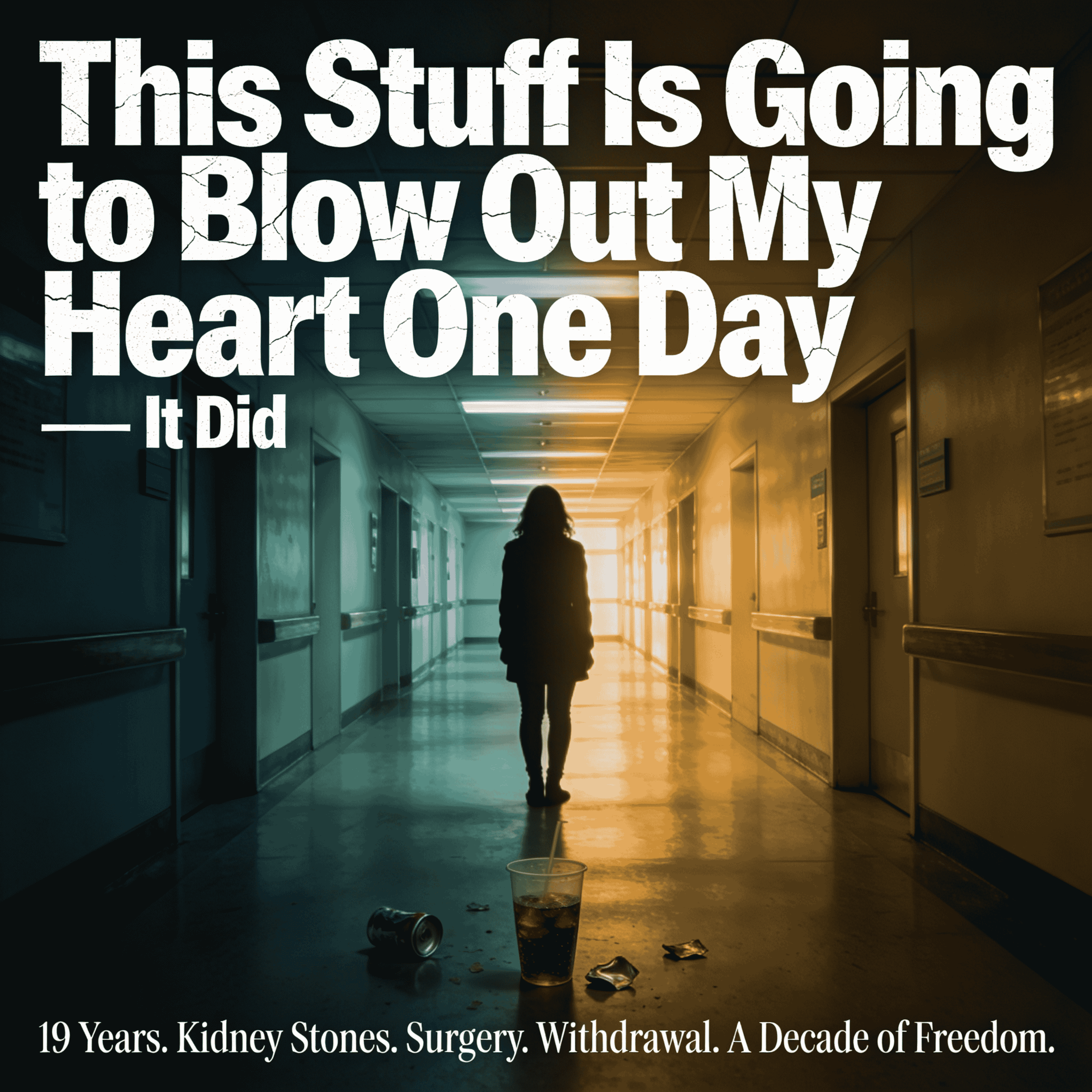
Her dietitian called her an addict, but it was “just soda.” This episode traces a 19‑year cola habit through glowing ceilings, kidney stones, and surgery — and ends with a 24‑year‑old coworker whose energy drink ritual really did blow out his heart
Mentioned in this episode:
chap 3 before postroll
chap 3 before postroll
Trailer 3
Trailer 3
after preroll 3
after preroll 3
Transcript
The first kidney stone attack happened when I was 21. I had just gotten home from work, had something to eat, and out of the blue I was knocked sprawling by this icepick-like agony tearing a hole in my side. I vomited in fear. After an hour I called the doctor who said that I had gas and not to worry. It was not gas, and I soon had my first ambulance ride. I spent a week in the hospital being poked and prodded. After being diagnosed, I was told to drink more water, was introduced to the healing powers of cranberry juice and sent home. I spent the next 19 years being rushed to the hospital emergency room many times for kidney stones. Women say that the pain is worse than childbirth. Men just wince and turn white when talking about passing a stone. Listen, we all talk about the grind, but most of you are subsidizing your hustle with a chemical loan you can't pay back. In this new series, Unwired, we aren't just talking theory. We're going into the dirt with 40 anonymous stories of people who thought they were using caffeine to be superheroes, only to realize it was the very thing dismantling their health and their marriages. This is the case study of the hidden tax on your ambition. Hey everyone, Al Kushner here. Welcome back to Unwired, where we map the exact strategies you need to break free from the cycles that keep pulling you back. Today's story starts with a word that stopped someone cold: addict. Not the kind in an alley, the kind sitting at a dinner table with a 2-liter bottle of Coke and a family history that made it almost inevitable. We're talking about soda, kidney stones, surgery, and a 24-year-old coworker who once said, "This stuff is going to blow out my heart one day." It did. Here's what I need you to hear: that moment where you say, "I am completely done," that isn't defeat. That is the prerequisite. That is the exact moment the exit door becomes visible. We aren't wallowing today. We are deconstructing. Breaking down how these cycles actually work so you can stop feeling trapped and start executing your exit. This is how you stay unwired. The real cost of soda. When my dietitian used the word "addict" to describe me, I was shocked. Weren't addicts those pathetic people who huddled in alleys looking to score heroin or cocaine? Looking back, the ability to abuse was certainly in my DNA. After my grandfather left for work in the morning, my grandmother washed his dishes, straightened the kitchen, and then sat down with her first cup of coffee of the day. It was black. For a mid-morning snack, she'd have a couple of cookies and another cup of black coffee. Lunch was a sandwich and a cup of black coffee. That one pot of coffee was heated repeatedly until she finished it and brewed another pot, which she, my grandfather, and my parents drank after dinner. Grandma was always on edge. The slightest noise had her jumping, gasping, and clutching her chest. She suffered from headaches and had a nasty temper. Come to think of it, everybody in the house was jumpy and suffered from headaches. Grandma's mother, my great-grandmother, was an alcoholic. So was Grandma's brother. Dad's relatives are all overweight salt and sugar junkies. For years, dinner for two of my aunts was a hunk of fudge, a handful of pretzels, and several glasses of soda. One of them suffers from Type 2 diabetes now, but can't understand how it happened. While growing up, I remember there was always alcohol in my house. We had a refrigerator just for beer and a full bar in the basement. It was all in the open, nothing was locked up. Yet no one in the house drank. It was all kept for entertaining, which my parents did plenty of. I think it being so freely available was what kept me from noticing it. Soda, on the other hand, was taboo. It was in the house, but Mom kept an eagle eye on it. Soda was restricted to special occasions. The reason? Soda was full of sugar, said my mother, and sugar rotted teeth. Funny, but we always had homemade cakes, pies, and cookies in the house, plus plenty of store-bought donuts and pastries. Apparently, for my mother, only soda contained sugar. I craved soda and often would sneak a whole bottle into my room along with a bowl of ice and drink glass after glass. Late at night, I would creep like a burglar down to the garage and return the empty glass bottle to the wooden case, making sure it was placed in the back row so a quick glance would only show the full ones in front. I often wonder if the original reason I fell so hard for soda was because it was banned in our house. Forbidden fruit, as we all know, tastes the sweetest. I found that I have an addictive personality. As a baby, the same story had to be read to me every night at bedtime. When I got older, I would request the same thing for lunch every day. I pretty much ate a cheese sandwich every day for lunch during my entire 12 years of school. To this day, I can go for weeks eating the same thing for lunch or dinner. In the situation of my getting hooked on soda, it was a case of an obsession turning into an addiction. My obsession with soda made me a caffeine addict. When I turned 16 and began driving, I was able to go out with my friends. We did not want anything but soda. It was the '70s, and all around us kids were smoking, drinking, and experimenting with drugs while we guzzled gallons of Coke and Pepsi. True, we were nerdy, old-fashioned kids, but two of my friends had parents who smoked, and we all hated the smell. Another had a father who became unpredictable and often violent after a night of beer drinking on the family couch. Drinking soda was safe, and we loved the giggly, all wound up feeling we got. We could sit and laugh and talk all night long, smug in the knowledge that we were having as much fun as the juicers, potheads, and dopers in our school, maybe more, since we weren't doing anything bad. Drinking soda wasn't dangerous. In the mid-'70s, there was a sugar shortage, so soda prices were very high. 2-liter bottles cost around $1.69, so like penny-pinching, coupon-cutting housewives, we were all on the lookout for the best prices. Sales were rare, so were coupons. One day, a friend called screaming as if she had just won the lottery. She and her mom had been shopping at the local Woolworth's and discovered a sale on Coke. Cases—four 6-packs—were selling for $5. I ran to the store and bought 6 cases. I kept them hidden in the trunk of my car, only smuggling in one 6-pack at a time. My mother would have nagged me and confiscated them had she known. It was winter, and I kept the cans in my bedroom window between the screen and the glass. I drank a 6-pack a night. Once, a can had frozen and was all bent out of shape. I opened it and soda exploded upward, spraying my face, hair, the wall behind me, the ceiling, my bed, and desk. Before I wiped up the mess, I reached for another can, gulped it down, and then went into the bathroom for some wet towels. I couldn't reach the spots on the ceiling or upper part of the wall, and these spots glowed slightly in the dark. My friends and I laughed and pondered what kind of chemicals were in the soda to make it glow. Of course, that didn't stop any of us from drinking it. My whole family had always been night owls and— Quick pause for a second. If you're hearing yourself in this book, I built two things to go deeper than this audiobook can. First, there's Unwired, a caffeine cessation app where you can track your own withdrawal timeline, sleep, mood, and crashes day by day. And inside Unwired, you can work one-on-one with a coach who actually understands caffeine addiction and will walk you through a real plan instead of you guessing alone. The waitlist link is at the very top of the description. Second, there's the Unwired podcast built around 40 real caffeine case studies Students, parents, founders, night shift workers walking through the same crashes you're hearing about right now. The link is right next to the app. If you want more than information, if you actually want a plan, a coach, and stories that feel like yours, hit those links, then come right back. I was an insomniac. I also suffered from headaches. As I got older, I began getting migraines, and I was noticing weight gain. Still, I didn't attribute it to my soda addiction. I was young, managing on 4 to 6 hours of sleep, and I was active, riding my bike and going for long hikes in the woods behind our house. The first kidney stone attack happened when I was 21. I had just gotten home from work, had something to eat, and out of the blue I was knocked sprawling by this icepick-like agony tearing a hole in my side. I vomited in fear. After an hour I called the doctor who said that I had gas and not to worry. It was not gas, and I soon had my first ambulance ride. I spent a week in the hospital being poked and prodded. After being diagnosed, I was told to drink more water, was introduced to the healing powers of cranberry juice and sent home. I spent the next 19 years being rushed to the hospital emergency room many times for kidney stones. Women say that the pain is worse than childbirth. Men just wince and turn white when talking about passing a stone. I was dutifully chugging my cranberry juice while continuing my romance with Coke. In 1985, Coca-Cola introduced New Coke, in which the company screwed with the original recipe. I don't recall any rioting in the streets, but people were angry. Roman Coke drinkers cried that the new Coke ruined the taste of their iconic drink, and many people rushed around buying up bottles and cans of old Coke before it went off the market. My friend Barb found a tiny grocery store out in the middle of nowhere selling old Coke and bought out their entire stock of 50 cases. She had to call her brother to come out with his pickup truck to help her carry them home. She generously sold me half of her haul. Through careful hoarding, I was able to ride out the disaster. Eventually, Coca-Cola realized the error of their ways and started offering both old and new recipes to consumers. Soon after, the New Coke died and was silently laid to rest. My once white teeth began taking on a brownish cast. Molars crumbled. My uncle once told me that if someone placed a tooth in a glass of soda, the tooth would dissolve. I laughed at him, but I cut down on my cola consumption, switching instead to caffeinated carbonated flavored waters. My weight kept creeping upward since now in my 30s I wasn't as active as I once was. The headaches got worse. There were more migraines and the trips to the emergency room for kidney stones were more frequent. My best friend's mother, who had been drinking a 2-liter bottle of soda every day for years, was diagnosed with diabetes. I went on a health kick and cut out salt and soda and lost 10 pounds. Didn't last. Of course, by now I knew that caffeine was the culprit causing the headaches, but I was caught in a conundrum. By giving up caffeine, I suffered terrible headaches and felt groggy. Staying on caffeine, I suffered headaches and was too wired to sleep. After years of living with the misery, pain, expense—ambulance rides are not cheap—and lost time due to a kidney stone attack, I swore it couldn't get any worse. Then one evening I went to the bathroom and saw the bowl was full of blood. This time, as the emergency room doctor was reading the x-rays, he showed me the kidney stone. It was huge. It was half the size of a dime, and considering the tiny tube the stone had to push pushed through, it was no wonder that I was bleeding. The stone was too big and would never pass naturally, so I would have to have surgery to remove it. On the day I had surgery, the nurse was chatting with me. He said, "I bet you're a big soda drinker." Surprised, I said, "Yes!" Then we compared our soda consumption histories, and he dropped a bomb on me: "Didn't anybody ever tell you that the carbonation in soda can cause kidney stones?" During many years of hospital visits and meetings with specialists, not even once was my diet discussed. Drinking lots of water and cranberry juice seemed to be the only cure for kidney stones. 10 years later, people are surprised when I mention carbonation. Quitting soda was harder than I thought. All those fun television ads of kids doing the do and magazine spreads of people enjoying a Coke and a smile were tough to see, especially when I knew that I couldn't have it. Soda's a lot cheaper nowadays, maybe because it has so much competition. Buy a large pizza and get a 2-liter bottle of soda for free. Free soda refills in restaurants. Who drinks water with their lunchtime burger and fries? Of course, Coke now came in cherry, vanilla, lemon, and black cherry vanilla. Didn't I owe it to myself to try these flavors? When I was weaning myself off caffeine, I shook. My hands trembled, and even my voice broke. My head throbbed. I had dry mouth, and I was tired after 8 hours of sleep. It was hard. It hurt quitting caffeine, but it was worth it. I hadn't had a kidney stone in 10 years. I haven't had a migraine in 10 years, and I rarely even get ordinary headaches anymore. Some of my friends have not been as lucky as I was in escaping the allure of caffeine. A few have diabetes now, others struggle with their weight. A young man I worked with had a heart attack last year. He was 24. He drank 2 energy drinks a day and prophetically said, "This stuff is gonna blow out my heart one day." It did. You just heard what 19 years of kidney stone attacks, ambulance rides, crumbling teeth, migraines, and a surgery table looks like when the culprit isn't heroin or alcohol, it's soda. And you heard how a 24-year-old coworker who drank 2 energy drinks a day said, this stuff is going to blow out my heart one day. It did. The world will never tell you that the free refill with your burger, the 2-liter with your pizza, or the energy drink at the checkout counter is slowly sending you a bill you cannot afford to pay. If any part of this story felt familiar, the hoarding, the rationalizing, the I'll quit tomorrow, don't white-knuckle this alone. The Unwired app is there to help you log your last caffeine use, track withdrawals, sleep, mood, and energy day by day, and get matched with a coach who actually understands what you're going through. The Unwired podcast goes deeper with 40 real caffeine case studies. Students, parents, founders, night shift workers walking through the same crashes, relapses, and breakthroughs you're hearing right now. And when you're ready to wear the decision out loud, use the merch store link in the description to grab caffeine cessation swag, mugs, shirts, and daily reminders that you chose your health over a cup of liquid. Save this chapter, send it to someone who says, it's just soda, and keep walking with us as we go deeper into what caffeine is really costing you. If you made it this far into The Truth About Caffeine, you already know this isn't just about coffee. It's about your nervous system, your sleep, your anxiety, and your life. If you don't want to do this alone, that's why I built Unwired. Inside the Unwired app, you can log your last caffeine use, track withdrawals, sleep, mood, and energy over days and weeks. See your own nervous system reset instead of hoping it's working, and get matched with a coach for one-on-one training so you're not white-knuckling this by yourself. Alongside that, the Unwired podcast walks through 40 real caffeine case studies, people who went from just coffee to energy drinks and pills and then back out. You'll hear their mistakes, relapses, and what actually worked. Both links are at the top of the description. Join the Unwired app waitlist for coaching and tracking. Listen to the Unwired podcast. Save this audiobook, send it to one person who needs it, and if you're stuck in that daily 2 PM crash, come do this with us inside Unwired, not just in your head.