Episode 21 · Duration: 16:13
About this episode
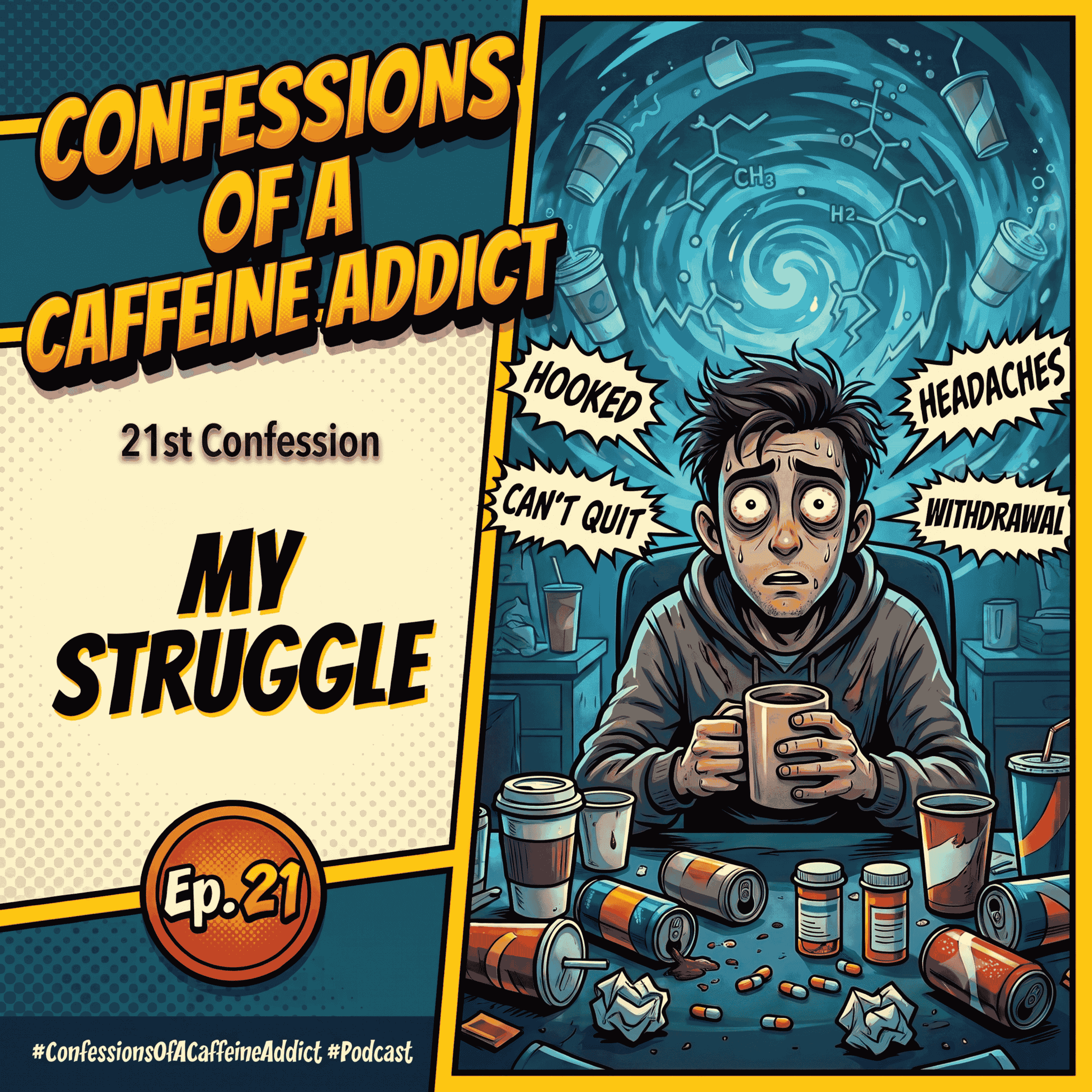
Some caffeine addictions begin during moments of extreme physical vulnerability, and this episode explores exactly that: a Pepsi habit that started in a hospital bed and grew into an 11-year prison sentence. What began as sipping soda to combat nausea escalated into 96 ounces of Coke or Pepsi daily, triggering fibrocystic breast disease, panic attacks, rosacea, and a decade of failed attempts to quit. The confession traces a raw cycle of relapse, denial, and self-loathing, culminating in a cold-turkey breakthrough sparked by an unlikely source: her own ten-year-old son
What You'll Hear in This Episode
- How a hospital stay and nausea medication led to a first sip of Pepsi that quietly became an 11-year caffeine addiction
- The steady escalation from 32 ounces of soda a day to 96 ounces, alongside fibrocystic breast disease, constant pain, and worsening headaches.
- The onset of panic attacks, rosacea, insomnia, and recurring urinary tract infections tied directly to daily caffeine intake
- Why quitting smoking and beating alcoholism felt achievable, while a "harmless" soda habit proved impossible to shake for over a decade
- The repeated cycle of tapering off, relapsing under stress, and using life events like surgery, holidays, and a funeral as excuses to stay hooked.
- A dramatic cold-turkey attempt fueled by Excedrin, followed by a husband's intervention that physically blocked access to a McDonald's Coke.
- The emotional turning point: a young son's simple wish that his mother would overcome her addiction, which instantly eased her cravings
Key Takeaways
- Caffeine dependency can take root in surprising circumstances, including illness recovery, long before anyone recognizes it as an addiction.
- Chronic high-dose caffeine intake can manifest as serious physical symptoms, including breast disease, panic attacks, and skin and urinary issues.
- Life stress is one of the most powerful relapse triggers, often disguised as a legitimate reason to delay quitting "just a little longer".
- Emotional connection, not willpower alone, can sometimes be the deciding factor that finally breaks an addictive cycle.
- Recovery from caffeine dependency is rarely linear; even months into sobriety, moments of doubt and temptation can resurface.
Who Should Listen
- Anyone who has used soda or caffeine as a coping mechanism during illness, stress, or major life transitions.
- Parents managing caffeine dependency while trying to model healthy habits for their children.
- Listeners interested in the physical toll of long-term high-volume soda consumption on breast, skin, and urinary health.
- Anyone who has repeatedly tried and failed to quit a habit due to ongoing life stress and relapse triggers
Resources & Links
🌐 Visit us at https://linktr.ee/UnwiredLife
📖 Confessions of a Caffeine Addict by Marina Kushner
📩 Share your own caffeine confession: https://linktr.ee/UnwiredLife
🛒 Live Unwired Media: LiveUnwired.org
Transcript
I was consuming about a gallon of Dr Pepper a day. Eventually, I got so sick of the taste that I quit drinking it cold turkey. A few days after my sudden break from caffeine, I got the worst migraine I'd ever had. I felt sick, continually throwing up, and spent days lying in the dark with a cold cloth on my head. After 3 weeks of pain, I went to a doctor. I told him I'd quit drinking soda about 3 weeks prior. He smiled and said, "I'll be right back." Listen, we all talk about the grind, but most of you are subsidizing your hustle with a chemical loan you can't pay back. In this new series, Unwired, we aren't just talking theory. We're going into the dirt with 40 anonymous stories of people who thought they were using caffeine to be superheroes, only to realize it was the very thing dismantling their health and their marriages. This is the case study of the hidden tax on your ambition. This is the case study of a drink that almost cost her a marriage, her health, and her sense of self. Welcome back to Live Unwired. Real stories from real lives transformed by one everyday drug most of us barely even question. This 21st confession doesn't have a title in the book, but we're calling it 11 Years in a Bottle. It starts with a medical crisis. Hospitalized with a serious kidney infection, on IV fluids and anti-nausea medication, she reaches for a Pepsi just to settle her stomach. That single can becomes the seed of an addiction that will imprison her for the next 11 years. What starts as 32 ounces of Coke or Pepsi a day Doubles to 64, then climbs to a staggering 96 ounces daily. The baby weight won't budge. Her breasts ache with constant pain and strange nodules, and she's eventually diagnosed with fibrocystic breast disease. Doctor after doctor tells her the same thing: stop drinking soda. She tries. She can't. Every attempt to taper off collapses the moment life gets stressful. And life always gets stressful. Panic attacks, rosacea, insomnia, recurring urinary tract infections, cramping, revolting digestion. She's already beaten smoking and alcoholism, so why can't she beat this? Friends tell her she's making mountains out of molehills. It's just soda, they say. She starts attending a church addiction recovery program, confusing everyone around her. Because how do you explain that a can of cola has you in its grip the same way a bottle or a needle has someone else? She can't even tell her own therapist. She's afraid of being labeled crazy, though by then she half believes she is. Then comes the breaking point: a lump in her breast, a scheduled biopsy. And 2 days before surgery, her children flood the bathroom of her brand new home. It's the perfect excuse to stay hooked. Even as she's already tapered down to a single 12-ounce can a day. Later, she'll finally understand the truth: the stress was never going to stop. She was the one who had to. Armed with Excedrin and sheer resolve, she quits cold turkey. She's short-tempered, sometimes downright mean. Every headache gets an Excedrin until one day she realizes 3 days have passed since her last dose. But the craving lingers for almost 3 weeks, sharpest every morning when she used to grab a Coke from McDonald's on the way to work. On day 20, her husband brings one home. She lunges for it. He's faster. He pulls it away before she can even close her lips around the straw and she explodes. She screams that she hates him and slams the door. Then, her 10-year-old son walks up and quietly tells her he hopes she gets over her caffeine addiction soon. Almost instantly, the craving disappears. 10 weeks later, she's still standing. No more headaches. More energy than she's had in years. Her breasts don't hurt anymore. She's not completely out of the woods, but for the first time, she can see the meadow, and it's gorgeous. This episode is brought to you by Live Unwired, liveunwired.org, a community helping people reclaim natural energy, deeper sleep, and real peace of mind without leaning on stimulants. LiveUnwired.org is the home base for this show and the gateway to 3 core resources from the Adrenal Foundation: The Truth About Caffeine, The Truth About Coffee, and Confessions of a Caffeine Addict: 40 True Anonymous Stories That Inspired This Series. Together, these 3 books give you the science, the lived experience, and the practical insight you need if you're ready to step out of the burnout loop and explore life with less or no caffeine. And if you recognize yourself in the edges of this story, you'll find support waiting at liveunwired.org. Now settle in for Confession 21: 11 Years in a Bottle. My Struggle. My name is Sarah, and I am an addict. I grew up in a dysfunctional alcoholic family. What you are told in therapy and in underage drinking prevention programs is that alcohol is a gateway drug. However, my gateway drug was caffeine. I was addicted to caffeine before I knew that it was an addictive substance, but I didn't realize it until I tried to quit. I was working at a fast food restaurant and going to school. When I started work, they handed me a uniform and a 32-ounce cup, which I could fill with as much soda as I wanted. Awesome! My parents never provided that much soda, so I thought it was great. Not long after I started working, I began experiencing heart palpitations. I didn't realize it was related to the caffeine in the soda. I was consuming about a gallon of Dr Pepper a day. Eventually, I got so sick of the taste that I quit drinking it cold turkey. A few days after my sudden break from caffeine, I got the worst migraine I'd ever had. I felt sick, continually throwing up, and spent days lying in the dark with a cold cloth on my head. After 3 weeks of pain, I went to a doctor. I told him I'd quit drinking soda about 3 weeks prior. He smiled and said, "I'll be right back." I figured he would write a prescription for some great migraine medication. Instead, he walked into the room with a can of Dr Pepper and said, "Take 2 of these and call me in the morning, haha." He explained that most people have to taper off caffeine to avoid the horrendous headaches that I was experiencing. He told me to drink 1 soda a day, then every other day, and keep lowering my caffeine intake. I swore that I would never become a caffeine addict again. A few years later, I was pregnant with my first child. To combat my morning sickness, which had gotten so bad that I required intravenous hydration and was on medication to keep me from throwing up, I started to drink Pepsi. It was the beginning of a caffeine addiction that would imprison me for the next 11 years. I started to drink 32 ounces of Coke or Pepsi every day. This doubled to 64, then 96 ounces. Ugh. I was miserable. I couldn't get rid of the baby weight, and my breasts hurt. I had constant pain and all sorts of nodules in my breasts. I was diagnosed with fibrocystic breast disease. The pain grew worse, and I began to have headaches again. One doctor or another told me to stop drinking soda, and I would try, but I couldn't. I was hooked and hated myself for returning to that point. I tried tapering off, but anytime I felt stress, I relapsed. Some people told me I was making mountains out of molehills because it was just soda. Why should I complain about an addiction to caffeine when I'd already quit smoking and was beating alcoholism? I began attending an addiction recovery program through my church, which perplexed some of my friends even more. I knew I was dumping empty calories into my body, but every time I stopped drinking soda, the side effects were so horrible that I gave up. I began to have panic attacks because of the caffeine in my system. I'd always been sensitive to medications, never realizing the full effect of the non-prescribed drugs that I was ingesting daily. I was plagued with insomnia and frequent urinary tract infections. My stomach began to revolt, causing cramps and, ooh, diarrhea. My parents told me horror stories about people they knew who had gotten sick, and it had been linked to sodas with artificial sweeteners. Quick pause for a second. If you're hearing yourself in this book, I built two things to go deeper than this audiobook can. First, there's Unwired. A caffeine cessation app where you can track your own withdrawal timeline, sleep, mood, and crashes day by day. And inside Unwired, you can work one-on-one with a coach who actually understands caffeine addiction and will walk you through a real plan instead of you guessing alone. The waitlist link is at the very top of the description. Second, there's the Unwired podcast, built around 40 real caffeine case studies—students, parents, founders, night shift workers, one walking through the same crashes you're hearing about right now. The link is right next to the app. If you want more than information, if you actually want a plan, a coach, and stories that feel like yours, hit those links, then come right back. I figured that I didn't need to worry because I was drinking regular full sugar soda, not the diet versions containing aspartame and other artificial sweeteners. My health continued to deteriorate. I developed rosacea. As my life was slowly crashing, I was constantly in a state of chaos. I always felt stressed. I yelled at my kids a lot, and I hated myself. I wasn't comfortable in my own skin. I started seeing a therapist, but I never brought up my caffeine addiction because I didn't want to be judged as a crazy person. Although I probably was. I was so stressed out, unhappy, and physically ill that I truly believed I had gone crazy. So did some of the people who were close to me. They didn't understand the addiction, and I hardly understood it myself. Every couple of months I tried to taper off. Then a stressful event would happen that I would use as an excuse to give up. There was one reason after another that I used to justify why I couldn't quit. I'd been thinking about quitting. I desperately wanted to quit, but I couldn't do it. About a year ago, I really was going to quit. I had found a lump in my breast and was going to undergo a surgical biopsy. Two days before I had surgery, my children flooded our bathroom and got caused $10,000 worth of damage to our brand new home. This was my reason to stay hooked even though I tapered off enough to be down to a 12-ounce can of Coke per day and already bought 6-ounce cans. There was a mixture of relief and self-loathing at the same time. I thought I would quit later after I got the mess cleaned up. Then it was, "As soon as the holidays are over." Then, "Let me get through Great Grandma's funeral." I finally came to understand one critical point: the stress was not going to stop, but I had to. Armed with Excedrin and a resolve to finally break the addiction, I gave myself a day to gear up and quit cold turkey. I was very short-tempered and sometimes downright mean. Every time I started to get a headache, I took an Excedrin. I was slowly able to increase the time between doses until one day I realized that 3 days had passed since my last dose. But for almost 3 weeks, not a single day went by that I didn't crave a Coke. I was in the habit of buying a Coke from McDonald's every morning. They have the best mix. And it turned out to be a very difficult habit to break. On the 20th day, my husband brought a Coke home from McDonald's. Quick as a fox, I grabbed it. But he was faster. He took it away before I could even close my lips around the straw. I was furious. I screamed at him, told him that I hated him, and slammed the door. I felt desperate and nearly began to cry. Then my 10-year-old son came up and told me he hoped I got over my caffeine addiction soon. Almost instantly, I began to feel better. My desire for Coke was gone. God had answered my prayers. The next morning came and I still didn't crave one. The next morning, I was still okay. I am really thankful my husband took that Coke away from me. It's been almost 10 weeks since I've had a Coke. Although I don't have the constant urge for caffeine and I am no longer counting hour by hour, it is still hard. The first time I ate at McDonald's after I quit, I felt like a former alcoholic in a bar. Couple of weeks ago, my husband was out of town again and I began to think that quitting was a mistake. Not having my husband around to hold me accountable, I knew I could buy a Coke and no one would ever know. But I also knew that if I had one Coke, I wouldn't be able to stop. Quitting has definitely been worth it. I no longer get headaches and have more energy than I have had in a long time. My mood is better, my breasts don't hurt, and I no longer feel like a prisoner in my own body. I am not out of the woods, but I see the meadow, and it's gorgeous. 11 years of just soda, countless failed attempts, and one simple sentence from a 10-year-old were what finally broke her bond with coke. She had already quit smoking and beaten alcoholism, yet the can in her hand proved to be the hardest addiction to face and the most invisible to everyone around her. Hearing her child say he hoped she'd get over her caffeine addiction soon reframed the habit as something bigger than cravings. It was shaping her family, her health, and her sense of self. If you've told yourself it's just soda or felt embarrassed to call your drink of choice a real addiction, this story is your permission slip to take it seriously. You don't have to quit overnight. You can start with one less can, one different choice, one honest conversation. For more true stories like this, practical tools, and a community exploring life beyond caffeine, head to liveunwired.org. If you made it this far into the truth about caffeine, you already know this isn't just about coffee. It's about your nervous system, your sleep, your anxiety, and your life. If you don't want to do this alone, that's why I built Unwired. Inside the Unwired app, you can log your last caffeine use, track withdrawals, sleep, mood, and energy over days and weeks. See your own nervous system reset instead of hoping it's working, and get matched with a coach for one-on-one training so you're not white-knuckling this by yourself. Alongside that, The Unwired Podcast walks through 40 Real Caffeine case studies, people who went from just coffee to energy drinks and pills and then back out. You'll hear their mistakes, relapses, and what actually worked. Both links are at the top of the description. Join the Unwired app waitlist for coaching and tracking. Listen to the Unwired podcast. Save this audiobook, send it to one person who needs it, and if you're stuck in that daily 2 PM crash, come do this with us inside Unwired, not just in your head.