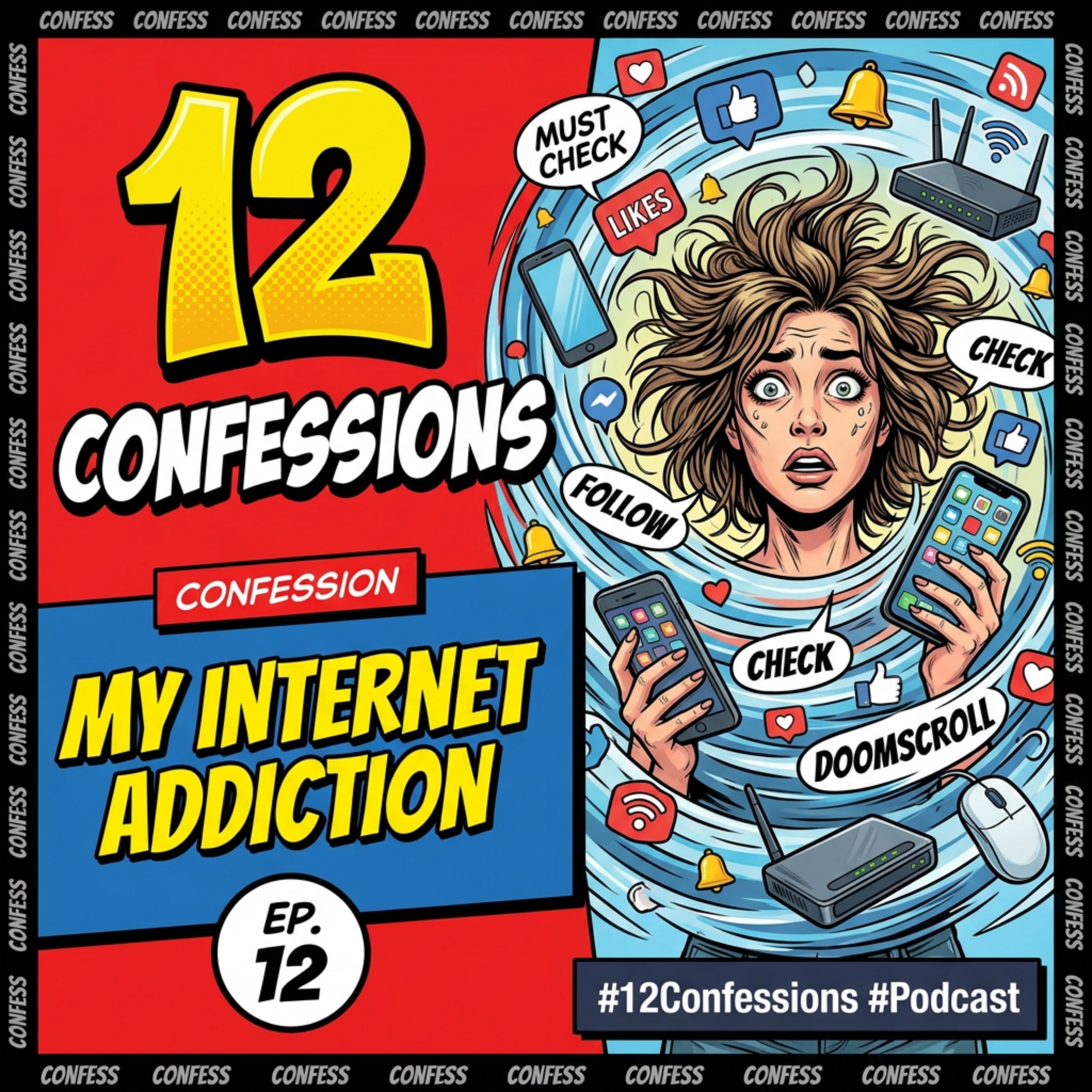
Episode 12 · Duration: 16:31
About this episode
Episode Summary
A journalist burning the midnight oil on a daily deadline discovers that her chest pains, irregular heartbeat, and shaking hands aren't a heart condition — they're caffeine. And the migraine medicine she was taking to cope? Also caffeine. This episode is a wake-up call for anyone in a high-pressure career who has convinced themselves they need it to perform.
What You'll Hear in This Episode
- A day-in-the-life inside a caffeine-fueled newsroom and what it actually costs
- The physical symptoms that finally sent her to the doctor — and the surprising diagnosis
- How over-the-counter migraine medication secretly prolonged her addiction
- The week-by-week withdrawal process and what helped her through
- What life looked and felt like on the other side — calmer, clearer, and fully present
Key Takeaways
- Chest pain, irregular heartbeat, and hand tremors can be direct signs of caffeine toxicity
- Common OTC medications, including Excedrin, Midol, and Tylenol for Migraines contain caffeine
- High-performance careers create environments where caffeine addiction is normalized and rewarded
- Withdrawal symptoms, including weight gain, irritability, and fatigue, are temporary
- Decaf and caffeine-free alternatives can satisfy the ritual without the dependency
Who Should Listen
- Journalists, healthcare workers, lawyers, and others in high-demand careers
- Anyone regularly taking OTC pain or migraine medication
- People experiencing unexplained chest tightness, heart palpitations, or hand tremors
- Anyone who has tried to quit caffeine and keeps getting pulled back in
Resources & Links
- 🌐 Visit us at https://linktr.ee/UnwiredLife
- 📖 Confessions of a Caffeine Addict by Marina Kushner
- 📩 Share your own caffeine confession: https://linktr.ee/UnwiredLife
- 🛒 Live Unwired Merch: LiveUnwired.org
Transcript
At this juncture, I was put on an assignment that required 3 days of rigorous shooting, along with all the complexities of getting a news story ready. At the end of the 3rd day, I collapsed in the office with extreme stomach pain. I was rushed to a hospital, and the checkup showed that I had colitis. The abnormal lifestyle had finally shown its ugly reaction. I was hospitalized for 3 weeks, and within that period lost the opportunity for the promotion, as my office needed someone to immediately fill the position. I saw well-deserved opportunities slipping out of my hand, and I could do nothing about it. The lack of proper food and the excessive consumption of caffeine on an empty stomach had ruined my digestive system completely. What broke my spirit at this point was the fact that I had no one around. Listen, we all talk about the grind, but most of you are subsidizing your hustle with a chemical loan you can't pay back. In this new series, Unwired, we aren't just talking theory. We're going into the dirt with 40 anonymous stories of people who thought they were using caffeine to be superheroes, only to realize it was the very thing dismantling their health and their marriages. This is the case study of the hidden tax on your ambition. Welcome back to Live Unwired. I'm Al Kushner. Today's confession comes from inside one of the most high-pressure environments. You can work in a newsroom. Deadlines, overnight shifts, breaking stories, and fueling all of it— caffeine. But what happens when the thing keeping you going starts shutting you down? This episode answers that question. Let's go. It's 1:40 AM. The newsroom is empty. A script still needs to be finished and a story still needs to be edited. That's the world this confession lives in. Every morning begins with a mocha from Starbucks on the way into the office, then another after lunch, then one more, and then one more after that. By afternoon, hands are shaking, keys are being missed, and the mind is running faster than the body can keep up. Chest pains, nausea, sweating, an early exit from the office, stopping at Caribou Coffee on the way home. At night, twitchy legs and a frightening irregular heartbeat. A doctor's appointment follows. Not heart disease, caffeine. The doctor warns that withdrawal won't be easy. Turns out even the headache medicine being taken for relief, Tylenol for migraines, contained caffeine. The addiction had been unknowingly refueled with every pill. Quitting means walking past Starbucks, holding breath to avoid the smell, declining coffee with a coworker named Mario, gaining 6 pounds, riding out the withdrawal week by week, and on the other side, Lower blood pressure, clearer mornings, a vanilla steamer at Starbucks, no caffeine, a new boyfriend who offers a sip of his decaf mocha and a gentle "no thanks" in return. Quantum of solace. The silence of the empty newsroom seems to engulf me. Not a soul around except for the night shift producer who, in a state of drowsiness, was gradually passing out on his chair. I stare at my watch. It's 1:40 AM. I still have to finish my script and then edit my story. The perils of working for a news channel. You just cannot escape the graveyard shift. I take a sip of herbal tea from my cup, a stimulant that would keep me awake for at least another hour now. I finish my script hurriedly and run toward the edit bay. The voiceover is done. I explain the edit to my editor and head back towards my desk. My herbal tea has gone cold sitting on my desk. I go to the pantry to make another cup. Spotting a darkened corner of the canteen room, I settle down for a few quiet moments and stare at my watch again. "October 6th," I mutter to myself. It was exactly one year ago that I had broken up with my boyfriend in this very room. Very quiet corner of my office canteen. The time and scenario have changed so much in the past year, but the memories of it don't cease to haunt me. The only thing that is still the same is the cup in my hand, a steaming cup of black coffee that helps me stay up during long working hours, a cup that was once filled with my addiction. My caffeine addiction started back in journalism school when all I cared for was meeting deadlines. I suppose the coursework was a training period for a life that I would be living eventually, continuing to meet deadlines. Pile of assignments, research papers, book reviews, and the unending stints in front of the laptop required the tedious task of staying up until the wee hours of the morning. My best friend could only be a mug of black coffee then. A shot of freshly made espresso and I was set for 2 hours of good, unblinking, nonstop study. That was followed with chains of cigarettes, and when the assignments were a matter of continuous sleepless nights, energy drinks joined the list of stimulants. What happened at the end of those sleepless hours is a different story altogether. I could easily describe myself as a zombie. The worst part came when I imagined myself sleeping for a long while to make up for the total deficit of sleep, but then found that I could not doze off because my brain was so wired with all the stimulants that it refused to rest. Those times were nightmarish. It did not dawn upon me exactly what I was doing and how it would affect me eventually. Back then, my life was goal-oriented. The main objective was to finish the assignment come what may and never worry about what lay ahead. My caffeine addiction continued for many years after that. After journalism school, I immediately started to work. The initial few months of the training period were manageable, but with the passing years, the workload only increased. From breaking news to running after exclusives, life for me as a reporter was always on the edge. It still is. The frustration and stress would only lead to a greater dependence on stimulants. Cigarettes increased from singles to packs, and water was replaced with coffee. The dependence was justified to me because reporters had to be mentally alert all the time. The competition between who gets the news first is fierce. One slack moment and I could miss an important detail or piece of information which could cost me my job. And in such a business, you can eschew mental peace, but not on an important piece of news. Each day would pass in a similar manner. My lifestyle had pretty much taken a lot away from me. As a result of sleep deprivation, dark circles under my eyes could only be managed with a dab of foundation. The loss of appetite from excessive consumption of caffeine harmed my liver, which affected me both internally and externally. The worst effect of my addiction came as a blow to me the day I realized that I had lost myself in it. I was not the old me anymore. I was jittery and would get ticked off at the slightest provocation. I would have bad mood swings and feel edgy most of the time. To be precise, I had lost my own peace of mind. Constant lack of sleep and loss of appetite, followed by artificial methods of keeping myself charged up, all added to my stress levels. Eventually, all of this started reflecting in my personal relationships. I was in a long-distance relationship with a guy I had known for 3 years. He was an engineer and was preparing for his MBA. Our schedules would never match. When he was free, I was caught with work, and when I was free, he was either at work or busy studying. The distance and communication gap started to get to me, and the issues in my personal life were adding to my overall stress levels. The pressure level at work would only continue to increase, and my increasing career responsibilities did not leave me the space to devote myself to the relationship anymore. The distance and the mental agitation would only result in ugly fights. My crankiness was slowly getting on my boyfriend's nerves, as I could not control myself and would lose my temper during conversations with him. At that time, I thought that the relationship was the root of all my anxiety and lack of peace, and that ending it would eliminate all my stress. Therefore, without any extra thought, I called off my 2-and-a-half-year rela— Quick pause for a second. If you're hearing yourself in this book, I built two things to go deeper than this audiobook can. First, there's Unwired, a caffeine cessation app where you can track your own withdrawal timeline, sleep, mood, and crashes day by day. And inside Unwired, you can work one-on-one with a coach who actually understands caffeine addiction and will walk you through a real plan instead of you guessing alone. The waitlist link is at the very top of the description. Second, there's the Unwired podcast built around 40 real caffeine case studies. Students, parents, founders, night shift workers walking through the same crashes you're hearing about right now. The link is right next to the app. If you want more than information, if you actually want a plan, a coach, and stories that feel like yours, hit those links, then come right back. Relationship with a man I had believed I would eventually marry. Meanwhile, I was heading toward a promotion at work. It seemed to be the best thing that could happen to me. I was so involved with my career and all that it entailed that everything else seemed frivolous to me. What I did not realize was that a job promotion would only mean longer hours and greater stress. The irony of it all was that I had stopped having a life of my own. It was almost as if I was married to my work. At this juncture, I was put on an assignment that required 3 days of rigorous shooting, along with all the complexities of getting a news story ready. At the end of the 3rd day, I collapsed in the office with extreme stomach pain. I was rushed to a hospital, and the checkup showed that I had colitis. The abnormal lifestyle had finally shown its ugly reaction. I was hospitalized for 3 weeks and within that period lost the opportunity for the promotion as my office needed someone to immediately fill the position. I saw a well-deserved opportunity slipping out of my hand and I could do nothing about it. The lack of proper food and the excessive consumption of caffeine on an empty stomach had ruined my digestive system completely. What broke my spirit at this point was the fact that I had no one around. I chose not to bother my family, who lived several miles away. In the tenure of my journalistic work, I'd lost many friends. They had somehow disappeared, presumably because of my own lack of communication. Also, I was without love. I had broken up with my boyfriend some months before. The problems between us only kept increasing to the point that my anxiety and agitation made me feel negative about everything around me. He insisted that I had become a changed person and was not the girl he had loved. Maybe I knew it myself, but when it came from the person with whom I had imagined spending a lifetime, it crushed my spirit. The solace again had come from work as I drowned myself in assignments. Lying on the hospital bed with not a soul around, I could not help but take pity on my own condition. I missed my ex immensely. But I knew that I had messed it up myself. It is this loneliness that bogs one down even more. I knew I had to make a new start. During those 3 weeks in the hospital, I read Sylvia Plath's The Bell Jar, one book that had changed my life. While the book was a dark, brooding tale of a girl suffering from neurosis, the idea that sleep deprivation could result in neurosis scared the daylights out of me. I became more aware that regular hours of sleep are important for healthy living. I read more about how one should prepare oneself before going to sleep, like taking a shower, having a mild drink, or listening to some soft music to soothe the nerves. The idea that I had been doing exactly the opposite all these years made me frustrated at my own lack of judgment. When I went back to work after a month's rest, a lot had changed around me and in me. I realized that in the quest for fame and recognition, I was slowly losing myself. I could not afford to do that anymore. The detox trip in the hospital changed my lifestyle to a large extent. The first step that I took was asking my boss to shift me to the desk. I figured that I was not in a state where I could handle the pressures of working as a field reporter. I knew I was making a compromise, but it was for my own good. And I was not regretting the step. The next step I took was joining an Art of Living course that combined yoga with meditation and a healthy lifestyle. The course helped me find peace within. This had been my search for years. Next, I reduced my caffeine intake. I could not cut it out completely. Addiction is like a first love. There's always a bit of it that is left in you. I still take my morning cup of black coffee to set me up for the day's drudgery. But now I eat something along with it. While in the office, I've replaced my cup of coffee with herbal tea. As a rule, I do not take caffeine in any form after 7 in the evening. I've reduced smoking and make sure I eat 4 to 5 small meals a day. I have learned to be happy and take things much more lightly than I used to, because at the end of the day, it's your mental peace that will ultimately help you go places. One can barter several things in life, but definitely not the happiness that one so rightly deserves. In the never-ending race of life, at times we forget exactly for what, and for whom, we are taking all the trouble, and at the end of the game, when we see it is us who have lost the most in the bargain, it simply becomes a delusioning journey. Having been a caffeine addict myself, I know how tough it is to give up that magic potion that can be the solution to immediate problems, but whose long-term effects are nothing less than scary. The tricky part of this addiction is that you do not even realize when it has turned into one. What starts as a lifestyle norm slowly takes over as an integral part of your existence before you even know it. The influence of this evil in disguise takes a while to recognize. I found my way out only when I knew that I had no other option but to get over my addiction. This confession shows just how embedded caffeine becomes in high-pressure careers, not just as a habit but as a survival mechanism. And it shows something else: caffeine can hide in plain sight, inside the very medicines people take to treat the symptoms it causes. Here's what I want you to take from this one: check your medicine cabinet. Seriously. Excedrin, Midol, Tylenol for migraines—many of them contain caffeine. You might be fighting the addiction with one hand and feeding it with the other without even knowing it. That's the kind of thing we talk about on Live Unwired. If you made it this far into "The Truth About Caffeine," you already know this isn't just about coffee. It's about your nervous system, your sleep, your anxiety, and your life. If you don't want to do this alone, that's why I built Unwired. Inside the Unwired app, you can log your last caffeine use, track withdrawals, sleep, mood, and energy over days and weeks. See your own nervous system reset instead of hoping it's working. And get matched with a coach for one-on-one training so you're not white-knuckling this by yourself. Alongside that, the Unwired podcast walks through 40 real caffeine case studies. People who went from just coffee to energy drinks and pills and then back out. You'll hear their mistakes, relapses, and what actually worked. Both links are at the top of the description. Join the Unwired app waitlist for coaching and tracking. Listen to the Unwired podcast. Save this audiobook, send it to one person who needs it, And if you're stuck in that daily 2:00 PM crash, come do this with us inside Unwired, not just in your head.