Episode 15 · Duration: 14:47
About this episode
Episode Summary:
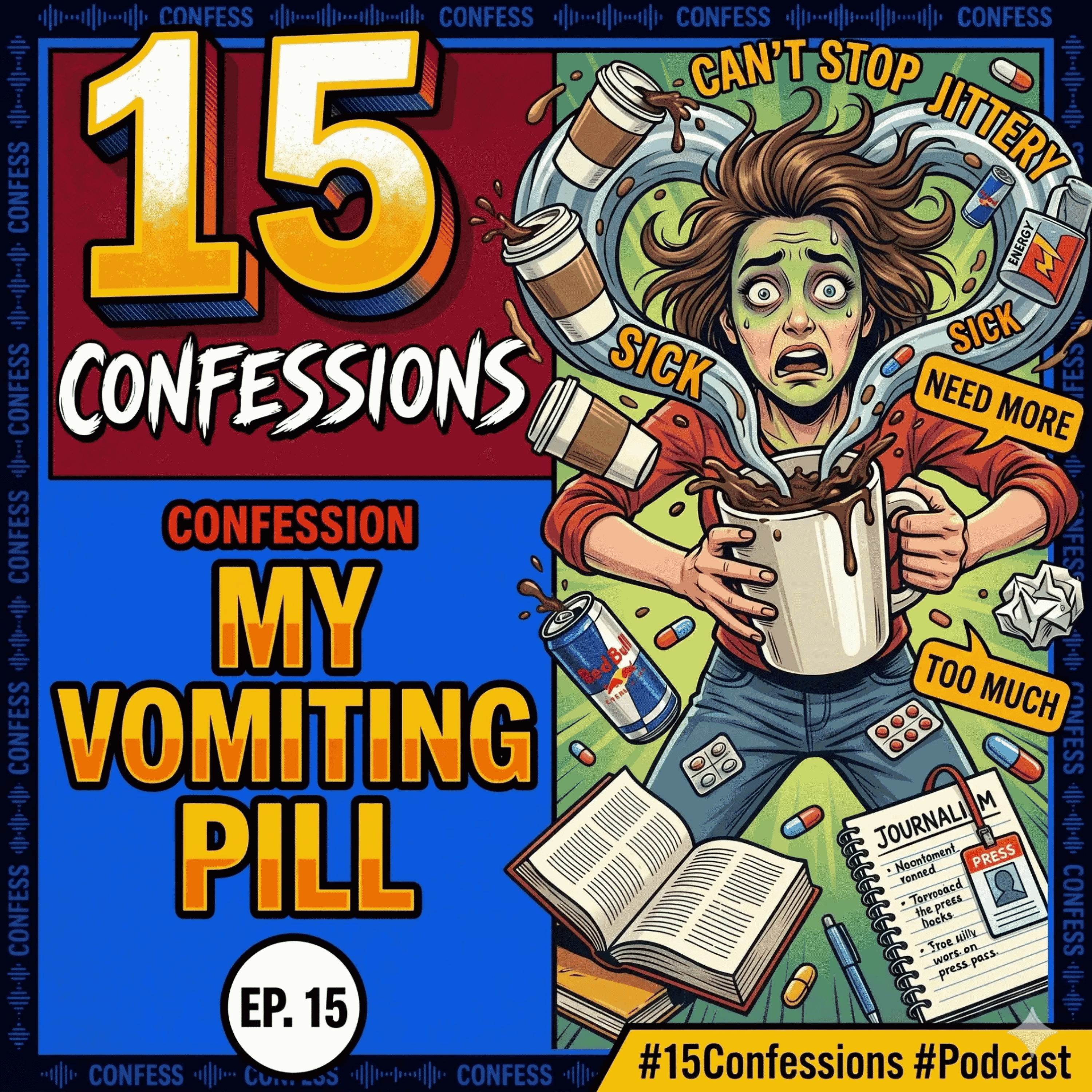
For a college journalist juggling classes and two jobs, coffee seemed like the only way to get everything done. It took a disastrous boat interview where a severe caffeine overdose triggered uncontrollable vomiting for her to finally say enough is enough. This confession is about the physical toll of stimulants, the illusion of productivity, and what happens when you try to swap coffee for black tea and end up right back where you started.
What You'll Hear in This Episode
- How a four-to-five cup daily habit created terrible migraines and nausea.
- The way caffeine crashes can actually drain your energy rather than boost it.
- What happens when a coffee overdose almost ruins a front-page newspaper story
- The hard truth is that switching from coffee to black tea can still lead to the exact same physical sickness.
- The physical relief and increased natural energy that come after completely kicking the habit.
Key Takeaways
- Caffeine can cause severe physical symptoms like migraines and vomiting when your daily intake fluctuates.
- We often convince ourselves that coffee makes us more productive, but the jitters can actually make us less efficient.
- Masking exhaustion with stimulants is an illusion that frequently leaves you more drained.
- Trading one caffeinated beverage for another, such as switching to tea, often doesn't address the underlying chemical dependence.
Who Should Listen
- Anyone juggling school and work who relies on caffeine to manage their heavy schedule.
- People who suffer from frequent migraines or stomach issues haven't considered their daily intake.
- Those who have tried to quit coffee by switching to tea but still feel sick.
Resources & Links
🌐 Visit us at https://linktr.ee/UnwiredLife
📖 Confessions of a Caffeine Addict by Marina Kushner
📩 Share your own caffeine confession: https://linktr.ee/UnwiredLife
🛒 Live Unwired Merch: LiveUnwired.org
Transcript
Although I religiously believed coffee gave me energy, the reality was that the caffeine crashes depleted my energy more than anything. When I got back to the office, I grabbed another cup of coffee at the liquor store downstairs. Before I took the last swig, my body was already shaky and I knew I had had too much. I was doomed to pay a heavy price for my obsession. Hours later, my head was spinning as I was trying to write the article. Listen, we all talk about the grind, but most of you are subsidizing your hustle with a chemical loan you can't pay back. In this new series, Unwired, we aren't just talking theory. We're going into the dirt with 40 anonymous stories of people who thought they were using caffeine to be superheroes, only to realize it was the very thing dismantling their health and their marriages. This is the case study of the hidden tax on your ambition. Hey everyone, Al Kushner here, and welcome to today's podcast. We are diving into the 15th confession from my book, which follows a college journalist who relied on massive cups of coffee to juggle classes and two jobs. She thought caffeine made her productive, but it actually triggered brutal migraines and uncontrollable vomiting that almost derailed her career. It is a harsh reminder that our go-to energy fix can often physically wreck us. We will explore her struggle to quit, the reality of her withdrawal, and how she later fell right back into the same trap with tea. Take a moment today to honestly evaluate how your own daily dose makes you feel physically. My Vomiting Pill. I cannot recall the specific day when I first had coffee or tried an energy drink, but but I will never forget the day I decided to quit. My addiction to caffeine started when I went to college. On a typical day, I would chug 4 to 5 cups of coffee. Sometimes I would chase the coffee with a sugar-packed energy drink. If I didn't have time to go to the coffee shop before class, I would feel edgy for the rest of the day. I always believed coffee made me accomplish more each day, but in actuality, I was so jittery that I was probably less efficient. I spent a lot of time and money on making coffee and buying coffee accessories. I became known for spilling my coffee in journalism class on a weekly basis. Once, when I was hyped up on coffee, I spilled my java across the conference table during my professor's lecture. I felt embarrassed at my clumsiness, but it was more than that. Coffee also changed my personality. I was impatient, short-tempered, and easily irritated. My justification for drinking coffee kept me addicted. I worked two jobs to put myself through college, and I was always searching for additional energy. It was a delicate balance. If I consume more or less than my usual coffee dose for a day, the result was a severe headache and fits of vomiting. Any noise or light would make my migraine symptoms worse. The only antidote: sleep in a dark, quiet room. The first time I overdosed on coffee, I had to drive about an hour and a half home from work in the middle of rush hour traffic, stopping to throw up along the way. For years, I would suffer from coffee-induced migraines, and my condition worsened with my increasing obligations. After the migraine set in, I would always vow to quit coffee, just like an alcoholic promises not to drink alcohol in the morning after a night of binge drinking. At my worst, I was getting about 5 to 7 hours of sleep a night and working 12 or more hours a day. My breath, hair, and skin reeked of coffee. It felt as if it was seeping out of my pores. The problem was that I loved coffee. I drank it socially with friends and family members and could not imagine handling my workload without the caffeine. What is so bad about coffee? There is a coffee shop on nearly every corner in almost every American city—at least the ones I've lived in. Everyone I know drinks coffee, including all the characters I've watched on TV. It is a socially acceptable addiction and comforting, so why should I want to quit? For a long time, no one could persuade me differently. So I continued to suffer with migraines and kept on drinking coffee. Then one day I finally had enough. It was summer and I was still living in Honolulu, Hawaii. I was reporting on a story about a teenager who was attempting to be the youngest person to circumnavigate the globe. At 7 o'clock AM, I was at the harbor waiting while a staff reporter corralled a speedboat so we could get exclusive shots and an interview with the young sailor before he docked. Holding the hot coffee in my hand, I boarded the boat. I nearly slipped getting onto the boat, but I didn't drop my cup of coffee. We raced out to sea and sped around the teenager's sailboat, snapping photographs and yelling inane questions at him. As we raced around the water, I struggled to keep my balance. I juggled my digital recorder, notepad, and precious coffee. The boat rocked back and forth, but I held onto my java. I genuinely believed that I could not be as productive without my My java. coffee. After an hour on the water, seasickness began to set in, and the only comfort I had was a bitter, now cold, cup of coffee. I finished it before we docked, but I still felt my brain cells dragging. I decided to drain the last bit of java that was left in a coffee pot inside the harbor office as the local TV crews wired the young sailor with microphones. Even after 2 cups of black coffee, I felt my energy already waning. And my eyes became weak and strained as the blue Hawaiian sky blared down on me. Although I religiously believed coffee gave me energy, the reality was that the caffeine crashes depleted my energy more than anything. When I got back to the office, I grabbed another cup of coffee at the liquor store downstairs. Before I took the last swig, my body was already shaky, and I knew I had had too much. I was doomed to pay a heavy price for my obsession. Hours later, my head was spinning as I was trying to write the article. I remember the young circumnavigator's first words to me as he anchored his boat: "Football season is starting now. They're all running and I can barely stand." He said this after a month of sailing from California to Hawaii. I too could barely stand, but all I had done was drink 3 very large cups of black coffee. I felt sick. I was running back and forth from my desk to the toilet, vomiting uncontrollably. It was not seasickness or the flu. The severe migraine was an indication that I drank too much coffee. I felt so sick that I did not care what the other women in the neighboring stalls thought as they heard me lose my breakfast and lunch in the bathroom. Nothing helped the nausea, and the fluorescent lights overhead in the newsroom seemed to worsen my symptoms. Staring at the beams of light over my desk, I thought, did those lights always flicker? Lights that I never noticed before seemed to glare like high beams on a pickup truck. My eyes were pulsating as I was— Quick pause for a second. If you're hearing yourself in this book, I built two things to go deeper than this audiobook can. First, there's Unwired, a caffeine cessation app where you can track your own withdrawal timeline, sleep, mood, and crashes day by day. And inside Unwired, you can work one-on-one with a coach who actually understands caffeine addiction and will walk you through a real plan instead of you guessing alone. The waitlist link is at the very top of the description. Second, there's the Unwired podcast built around 40 real caffeine case studies. Students, parents, founders, night shift workers walking through the same crashes you're hearing about right now. The link is right next to the app. If you want more than information, if you actually want a plan, a coach, and stories that feel like yours, hit those links, then come right back. "Fiercely trying to finish the story, just as I was about to run to the ladies' room for another barf break, my editor tapped me on the shoulder to tell me my story would appear on the front page the next morning. My head dropped onto my sweaty palms." Usually journalists love the recognition front-page coverage brings, but getting the lead story meant I would have to type up another paragraph for the COVID page. I could barely work for another few minutes, and I only had a few hours before I had to go to my next job. Shaking from the migraine, I phoned my boss at my other job and asked for a sick day. He joked that I should never combine boat trips and cheap coffee. Hehe. All I could say in response was, I don't drink cheap coffee. After I finished the article, I drove myself home, stopping intermittently to vomit on the street. On that day, following my boat ride, I lay in the cold bathtub in pain as pellets of water fell on my body. I swore to finally quit drinking coffee. I was tired of being sick. I was tired of missing work because of my migraines. I was fed up with explaining my condition to friends, coworkers, and family members. The next morning after I decided to quit coffee for good, I figured I would feel better, but I was wrong. The withdrawal symptoms from kicking my coffee habit cold turkey turned out to be worse than the migraines. I was vomiting for 4 days straight, and I had to postpone work and school obligations while I recovered. My coworkers were concerned about me, and each one took turns asking, "Is it food poisoning?" I was tired of explaining that coffee caused me to become severely sick. Why could they not understand that? Maybe they did not realize that coffee was addictive and that someone could suffer from withdrawal symptoms. Coffee simply did not agree with my system, and I was determined to stop this time. I decided, "No more coffee for me." The only question was, how would I get energy? For a while, I went without coffee, but there were a few incidents I admit when I gave in. Each time I would become physically sick. I upped my exercise routine and changed my diet to get more energy. Surprisingly, I found that I had more energy without coffee. I also took supplements and vitamins on a daily basis rather than randomly throughout the week. My belief that coffee gave me additional energy turned out to be completely false. The coffee crashes depleted my energy resources more than anything. After quitting coffee, I felt healthier and more productive. Best of all, My migraines disappeared, at least temporarily. After finally kicking my coffee habit, I soon developed a dependence on black teas. I started drinking 1 to 2 cups of tea a day, using 2 tea bags per cup. Slowly, as my obligations increased, so did my tea intake. I never thought I would suffer from debilitating migraines again, but I was wrong. Tea seemed less intense than coffee, so I did not feel my health was in any danger from drinking mass amounts of tea. I should have listened to my mother. She was always doing internet research about migraines. Perhaps she thought I had a tumor or something else serious. My migraines worried her constantly. I felt sick with guilt. One day before work, I drank about 4 to 5 cups of tea on an empty stomach. By the time I got to work, I had thrown up twice, once in a crowded McDonald's bathroom and later on the curb in front of work. 20 minutes into work, I had to leave because I was running back and forth to the bathroom. Since the unisex bathroom was located near my coworker's desk, I did not even have to explain. He heard me vomit up the Sprite I bought at the liquor store after I had vomited at the McDonald's. I know my reaction and dependence on caffeine is not unusual, although it is very extreme. Just in my circle of coworkers and friends, I know numerous people who continue to drink coffee despite suffering from migraines. Why? They are addicted, just as I was. We are all overworked and sleep deprived, looking for supplemental energy. Coffee is still a common craving of mine. Whenever someone is brewing coffee, I stop to inhale the aroma. I sometimes cave in and drink a cup, but I always become sick afterward and have to deal with a migraine. Although I often cannot fight my caffeine cravings, I have eliminated caffeine from my daily routine. I am not prepared to sacrifice my job and relationships for a sip of java. For me, the undergraduate who is inseparable from her coffee mug, that is a huge accomplishment. Quitting coffee and tea meant entirely changing my life. For years, I had been accustomed to toting around my coffee mug. I still have my collectible coffee mugs in my cupboard. I even had the perfect purse with a large outside pocket for my mug. On the plus side, deciding to stop drinking tea and coffee meant white teeth, fresh breath, and some extra pocket change. After I kicked my caffeine addiction, I would not have to religiously whiten my teeth several times a month or carry around perfume to disguise the coffee odor. Now I have more natural energy. I do not have migraine headaches anymore, and if I need an energy boost, I simply exercise, get some fresh air, and drink lots of water. The quality of my life and health has greatly improved, but I had to learn the hard way about caffeine addiction. That wraps up the story of our college journalist, and I think it shows just how sneaky caffeine dependence can be. She eventually traded her coffee for black tea, but her body still reacted with the same awful migraines and nausea. It is a tough lesson, but it really highlights that masking exhaustion with stimulants often backfires and leaves you feeling much worse than before. If you are dealing with unexplained headaches or stomach issues, Taking a break from all forms of caffeine can be a real eye-opener. What is one small step you can take tomorrow to start swapping out your daily dose? If you made it this far into The Truth About Caffeine, you already know this isn't just about coffee. It's about your nervous system, your sleep, your anxiety, and your life. If you don't want to do this alone, that's why I built Unwired. Inside the Unwired app, you can Log your last caffeine use, track withdrawals, sleep, mood, and energy over days and weeks. See your own nervous system reset instead of hoping it's working. And get matched with a coach for one-on-one training so you're not white-knuckling this by yourself. Alongside that, the Unwired podcast walks through 40 real caffeine case studies. People who went from just coffee to energy drinks and pills and then back out. You'll hear their mistakes, relapses, and what actually worked. Both links are at the top of the description. Join the Unwired app waitlist for coaching and tracking. Listen to the Unwired podcast. Save this audiobook, send it to one person who needs it, and if you're stuck in that daily 2 PM crash, come do this with us inside Unwired, not just in your head.