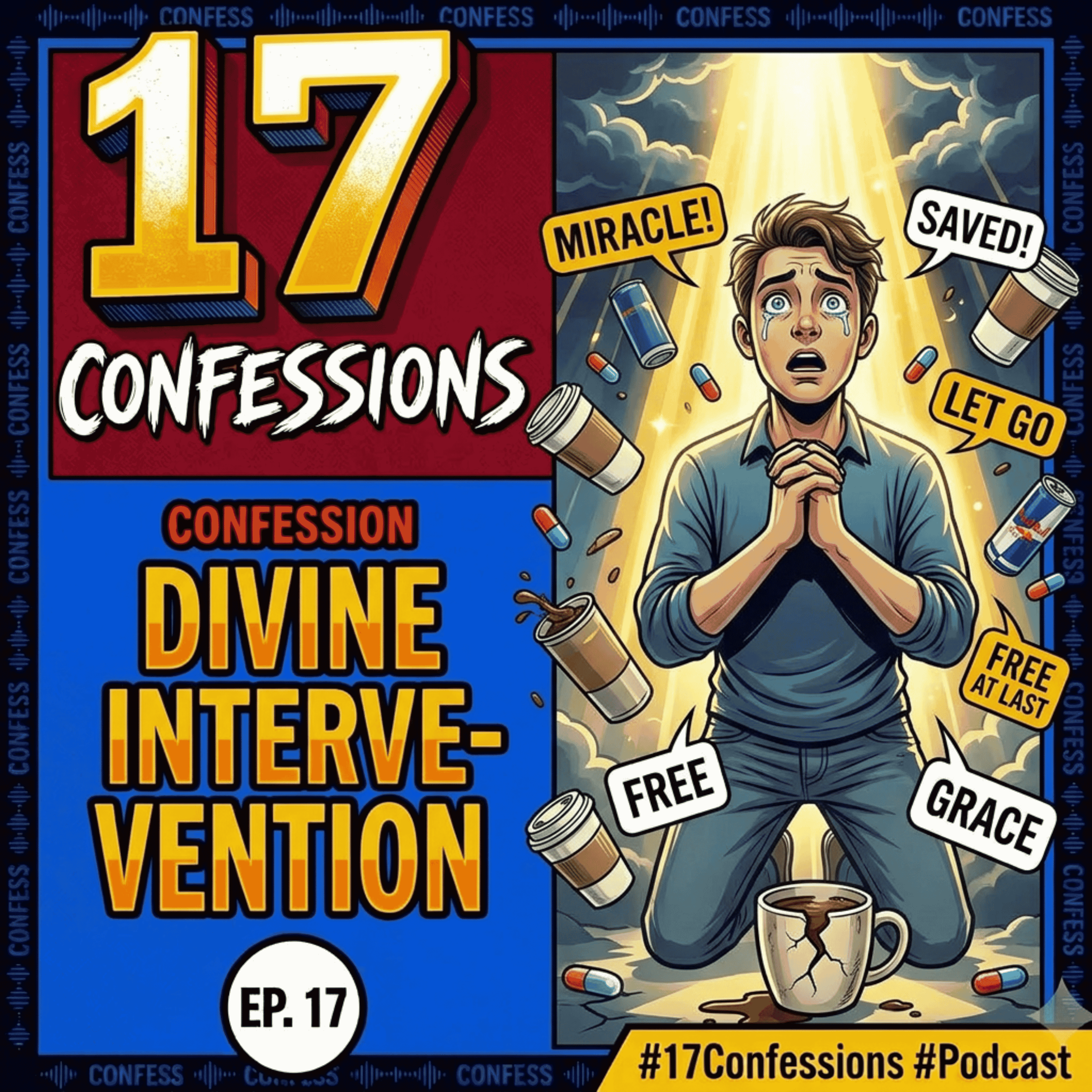
Episode 17 · Duration: 15:14
About this episode
Episode Summary:
For a woman growing up in a family of coffee enthusiasts, a daily routine of heavy caffeine use seemed entirely normal until it began quietly eroding her health. It took years of agonizing insomnia, severe mood swings, and a frustrating battle with unexplained infertility to finally look at her favorite beverage with clear eyes. This confession is about cultural habits, the heavy burden of silent health disruptions, and the profound transformation that happens when you finally taper off the drug and give your body a chance to heal.
What You'll Hear in This Episode
- How an absolute rule against childhood caffeine turned into an intensive daily habit the second the teenage years arrived.
- The way a marital home filled with constant coffee rounds drove an intake up to ten large mugs a day.
- How severe sleep deprivation and escalating insomnia were wrongly blamed on a new environment instead of the real culprit.
- The emotional toll of a primary fertility roadblock that medical doctors completely missed during years of normal testing.
- What a chance intersection with a naturopathic practitioner did to instantly crack open a deep-seated denial about a legal stimulant.
- The methodical, step-by-step strategy to slowly decrease daily mugs and handle strong mental cravings without completely shocking the system.
Key Takeaways
- Culturally accepted family patterns can easily mask the reality of a true chemical dependence.
- Chronically high levels of caffeine can quietly create devastating physical system disruptions, including severe insomnia and infertility.
- When trying to dismantle a long-term habit, a gradual tapering process is often a much more sustainable path to recovery than quitting cold turkey.
- The toxic mental load of severe irritability, anxiety, and mood swings can melt away once the underlying chemical driver is completely extracted.
- Reclaiming your natural physical balance can unlock life-changing health victories, sometimes through the simplest lifestyle changes.
Who Should Listen
- Anyone raised in a heavy coffee-drinking household where a warm mug is tied directly to comfort and hospitality.
- Individuals who are currently wrestling with stubborn, long-term insomnia cannot seem to find a lasting cure for sleep problems.
- Women experiencing the deep stress of unexplained infertility when all standard medical evaluations come back normal.
- Anyone seeking validation that legal, everyday stimulants can alter your mental peace and keep your physical system entirely out of whack.
Resources & Links
🌐 Visit us at https://linktr.ee/UnwiredLife
📖 Confessions of a Caffeine Addict by Marina Kushner
📩 Share your own caffeine confession: https://linktr.ee/UnwiredLife
🛒 Live Unwired Merch: LiveUnwired.org
Transcript
Like cigarette smoking, it is a mental trick to have coffee as a quick fix to any problem. After drinking that cup, we fool ourselves into believing that the caffeine shot did us some good, but nothing is further from the truth. Week after week, I steadfastly continued my ordeal. In 8 weeks, I had reduced my coffee intake to just 2 full cups in the morning. It had been one of the most difficult, Mentally traumatic times of my life. Listen, we all talk about the grind, but most of you are subsidizing your hustle with a chemical loan you can't pay back. In this new series, Unwired, we aren't just talking theory. We're going into the dirt with 40 anonymous stories of people who thought they were using caffeine to be superheroes, only to realize it was the very thing dismantling their health and their marriages. This is the case study of the hidden tax on your ambition. Hey everyone, Al Kushner here, and welcome back to the Live Unwired podcast. Today we are exploring a story about a woman whose heavy coffee habit contributed to severe insomnia and frustrating struggles with infertility. Coming from a family of coffee lovers, she didn't initially suspect her daily mugs were disrupting her physical health. After a friend convinced her to slowly taper off caffeine, her sleep returned to normal, and she was finally able to conceive a child. This narrative can be a powerful reminder of how our daily stimulant use can throw our natural systems far out of balance. It is definitely worth examining how your own habits might be quietly affecting your body. Divine Intervention. I grew up in a family of coffee lovers in the buzzing city of Mumbai. The rule at home, however, was that children should not be permitted to drink beverages like tea and coffee until they entered their teens. So even though the coffee aroma always tempted me as a child, it was only on the evening of my 13th birthday that I first tasted it. I was a happy, bubbly girl who sailed through her teens with no major health problems. Little did I realize the influences this first mug of coffee and the effect it would have on my life. Coffee soon became a part of my daily routine. I woke up to a steaming mug of coffee in the morning and topped it off with more cups during the day. I really loved coffee and was never tired of it. It became my staple and my mid-morning fuel. The taste of other drinks paled by comparison. My coffee intake was a minimum of 4 large mugs and a maximum of 10 on days when I was staying up late preparing for college exams. Later, when I married, I moved in with my husband's family, also big coffee enthusiasts. Every other hour there would be rounds of coffee prepared for everyone. If we had any visitors, we would serve them coffee as well, and the entire family would join in, having yet another cup for the day. Through all those years, I did not realize what coffee was doing to my sleep pattern. As I was edging toward my mid-20s, I began staying up later, more than usual. This happened over a period of years. I could not easily slip off to sleep and would stay up almost half the night tossing and turning. At first, I attributed these new insomniac patterns to the changes in my environment—a new home, new people around me—and I thought perhaps I was inwardly struggling to settle down. However, things did not get any better, even after 2 years of marriage. I could not fall asleep until late at night and struggled to wake up on time every morning. Like most married women, I was eager to start a family. My husband and my in-laws were equally keen. I did not realize this then, but we had not used any contraceptives for the first 2 years of our marriage. Yet I had not conceived. Oddly, I did not find this unusual. Then began the months and months of trying to conceive. This led to disappointment and as my cycles remained as predictable as ever. I had already celebrated my 28th birthday, and the pressure was mounting from my family and in-laws. Back home in India, neighbors took as much of an interest in my life as did my family. Questions were being asked, eyebrows were being raised. Isn't she almost 30? Are they still not trying for a baby? I felt more pressure than my husband did. For nearly 2 years we tried to have a child, keeping a chart, understanding the fertile time of the month and so forth. Our efforts were in vain. Why was I being singled out by God, I wondered? When would the neighbors stop talking? The only solution to this was to get pregnant and to get pregnant fast. This entire thought process stressed me out even more and compounded my insomniac tendencies. Finally, heeding advice from my family and friends, my husband and I decided to consult a doctor who specialized in fertility treatments. He ran a series of tests on both of us, trying to identify the problem. All results were normal. My husband's sperm count was fine, and my related hormone levels were perfect. The doctor said, "Stress can cause delays in conceiving, so just relax." 'Stop thinking about it. There is nothing wrong with either of you. Just keep trying.' Just keep trying? Wasn't that exactly what I'd been doing for the last 3 years? This abnormality, as I began calling it, was driving me nuts. I had frequent spells of weepiness every other day because of this. My relationship with my husband began deteriorating as I picked frequent quarrels with him for the smallest reasons. Those were the first signs of depression that I did not yet recognize. I began getting on his nerves with my constant mood swings, which only got worse with my inability to sleep properly. I used to lie awake in bed until the wee hours while he slept peacefully, which exasperated me even more. One day I bumped into an old college mate of mine who had begun practicing naturopathy. At that time I had not heard about such a thing, and I did not have access to Wikipedia as we do nowadays. This friend began explaining to me what she did, how she started believing in natural cures for common ailments after a life-altering incident in her own life. We chatted for a long time, sitting in a restaurant, and during our conversation she learned about my inability to conceive. Providence, I would call it. My meeting her after all these years of despair, at that opportune time in my life, was sheer divine intervention. Within 10 minutes of telling her about my plight, about the medical tests, my cycles, and my diet patterns, she said one word: "Caffeine." While I did not understand what she meant by that, I watched as she began mulling over my problem. Asking me seemingly irrelevant questions about my diet. Finally, she announced very convincingly, "It's the coffee that is the culprit. Stop or at least reduce your coffee consumption. Here's my number. Call me anytime you want, but do call me after 3 months to let me know how you are progressing." To me, this sounded totally absurd. I was aware that coffee contained caffeine, but I did not look at it as a drug that could be harmful. All the adults in my own family and those in my in-laws' house had been drinking coffee for years. Everyone was still alive with no major health concerns, and none of the married women in the family had any difficulty conceiving. Therefore, it did not make sense. What did she mean? Could she have a point? I wasn't sure, but I kept thinking about her words all through my journey back home that evening. It took a couple of days for this new information to sink in. With my limited spiritual growth then, I did not understand that anything that has the ability to get you addicted would not do you any good. But I resolved to give her theories a shot anyway. I had nothing to lose, really. I did not try to give up coffee completely. I knew I didn't have it in me to give up a habit that had been with me for over 15 years. My body demanded coffee every morning. I tried to reduce the amount in each cup, but after an hour or so my mind would demand it again. I would take another half cup to appease my craving. This went on all day long, day after day. After about a week I realized that I had actually cut down a cup or two. Hooray! Of course, all through this ordeal I had only my naturopath friend to depend on for moral support. My husband's family did not notice that I was trying to reduce my caffeine consumption. Since they themselves were coffee addicts, I did not want them to scoff at me and my idea. Nor did I confide in my husband about my attempt to reduce my caffeine intake. I will not deny that I had those weak moments when I just wanted to give in to the temptation of having a random cup during the day. Like cigarette smoking, it is a mental trick to to have coffee as a quick fix to any problem. After drinking that cup, we fool ourselves into believing that the caffeine shot did us some good, but nothing is further from the truth. Week after week, I steadfastly continued my ordeal. In 8 weeks, I had reduced my coffee intake to just 2 full cups in the morning. It had been one of the most difficult, mentally traumatic times of my life. Giving up the afternoon cup was the hardest, as I believed that it perked me up and kept me going for the rest of the day. I did eventually give up that afternoon cup, which actually helped to cure my insomnia. I was thrilled! I did not realize until I took control of the situation that I had been sleeping much better in the last couple of weeks. It had been coffee all along! How could I have been so daft in not linking the two? Because I began sleeping better, my mood improved and I was less irritable with my husband. The neighbors' talk did not bother me anymore. I was able to smile it off, inwardly thinking that I might just surprise you all in 6 months, just you wait and watch. My ability to sleep better greatly contributed to my positive frame of mind during the day., which in turn contributed to a healthy dose of lovemaking at night. I realize now how important sleep really is to our physical and mental well-being. My menstrual cycles, meanwhile, continued to be as regular as ever. I continued to talk to my naturopath friend, Ofendahn. She had asked me to call after 3 months to discuss my progress with kicking the coffee habit. However, there was no need for that since we seemed to be in constant telephone contact ever since the fateful day that we met. Then it happened! I missed a cycle! I was jubilant, but wanted to wait a few more days before I went in for a test. Two weeks later, my doctor confirmed that I was pregnant! I will admit that I had been a skeptic. I would have attributed all of this to mere coincidence or the result of reduced stress that helped me to conceive. Maybe solving the insomnia problem by giving up coffee was a part of the solution. All of this might be true to some extent, but more than anything, I believe it was caffeine that had caused my infertility. I will not lie and say that I have entirely given up coffee drinking. I still enjoy my one and only morning cup, but there is no more feverishness attached to it. I can live without it. On the days that I don't get my coffee, I don't break into a sweat or get headaches like I used to in the past. Now, thanks to the internet and information-rich websites, I have found enough evidence against caffeine, its links to insomnia, infertility, the mind's dependence on caffeine, and so much more. Today, when I look back on my ordeal of curing infertility by reducing caffeine, I marvel at the simplicity of it all. Sometimes the best things in life are surprisingly simple, if only we knew how to be aware of them. If you made it this far into The Truth About Caffeine, you already know this isn't just about coffee. It's about your nervous system, your sleep, your anxiety, and your life. If you don't want to do this alone, that's why I built Unwired. Inside the Unwired app, you can log your last caffeine use, track withdrawals, sleep, mood, and energy over days and weeks. See your own nervous system reset instead of hoping it's working. And get matched with a coach for one-on-one training so you're not white-knuckling this by yourself. Alongside that, the Unwired podcast walks through 40 real caffeine case studies. People who went from just coffee to energy drinks and pills and then back out. You'll hear their mistakes, relapses, and what actually worked. Both links are at the top of the description. Join the Unwired app waitlist for coaching and tracking. Listen to the Unwired podcast. Save this audiobook, send it to one person who needs it, and if you're stuck in that daily 2 PM crash, Come do this with us inside Unwired, not just in your head. Hey, that wraps up this episode. I think this story highlights how caffeine can quietly disrupt our physical health. She spent years dealing with severe insomnia and the heartbreak of infertility without realizing her heavy coffee habit was a major contributor. For some people, slowly tapering off caffeine can be the missing puzzle piece for restoring their natural balance. I am so glad she was finally able to conceive after making that tough lifestyle change. I suggest taking a close look at your own daily intake this week to see how much of the stimulant you are really consuming