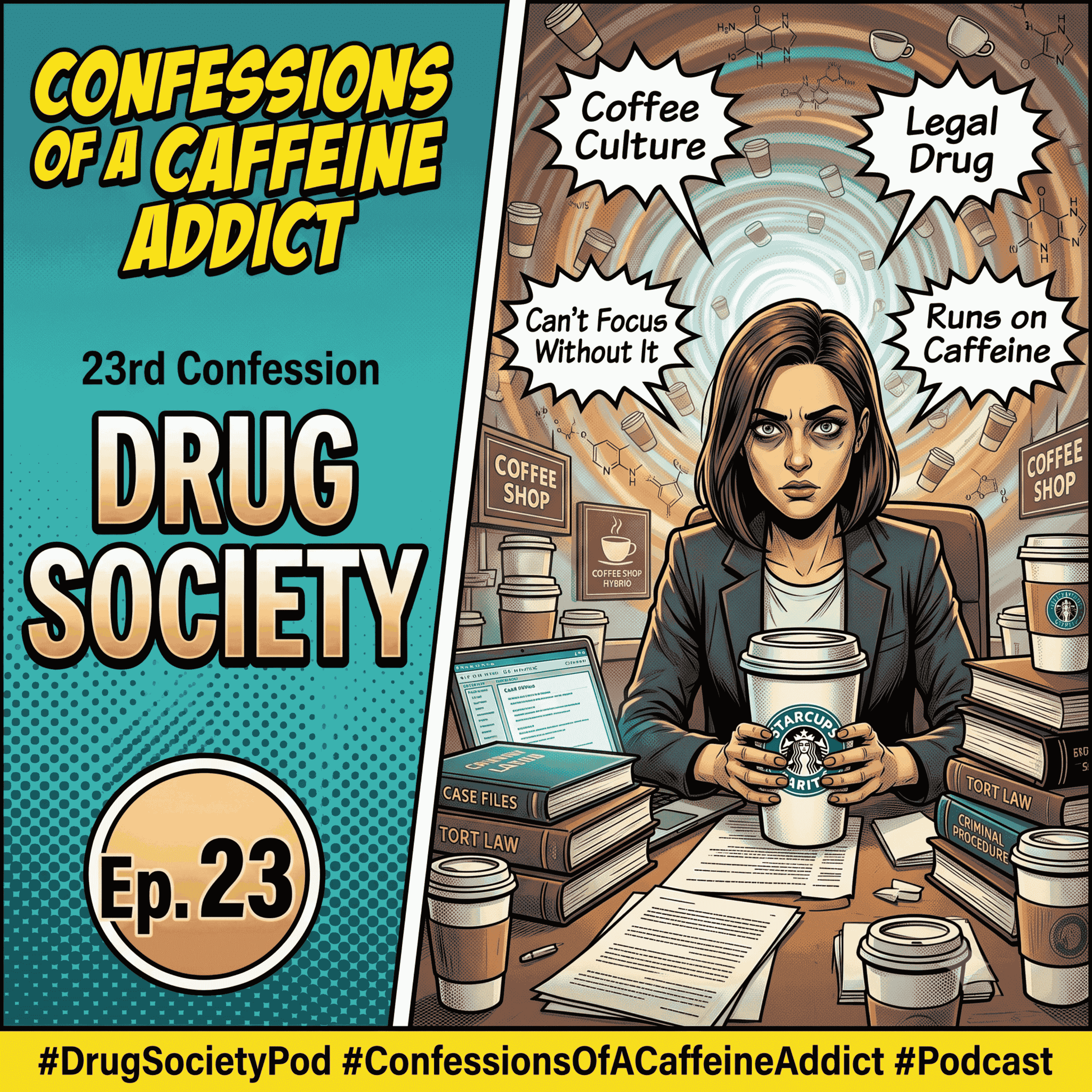
Episode 23 · Duration: 19:39
About this episode
Two lawyers—both self-described caffeine addicts—confess how law school coffee culture spiraled into a daily necessity neither could shake, even after a deliberate, disciplined attempt to quit. This episode explores "Drug Society," a candid look at how corporate coffee culture, peer pressure, and workaholism combine to normalize addiction hiding in plain sight. It follows a couple's structured plan to taper off caffeine, their painful three-week failure, and the sobering realization that a single cup of coffee revealed just how deep their dependency ran.
What You'll Hear in This Episode
- Why the narrator frame modern coffee culture as a "Drug Society," comparing Starbucks to a corporate enabler on every street corner?
- How law school peer pressure turned a coffee-avoider into someone drinking six or seven large mugs a day by graduation.
- The couple's failed attempt to switch to tea, discovering it took several cups to match the effect of a single cup of coffee.
- A structured tapering plan using decreasing percentages of decaf, and how quickly headaches, irritability, and fights followed.
- A workplace near-miss when a missed legal detail, caused by caffeine withdrawal fog, nearly jeopardized a client's case.
- The emotional breaking point was when one partner declared she couldn't function without caffeine, ending their three-week quit attempt.
- The unsettling morning, both admitted defeat, brewed fresh coffee, and finally recognized the true depth of their addiction.
Key Takeaways
- Corporate advertising and everyday culture can normalize caffeine dependency to the point where addiction goes unrecognized for years.
- Peer environments, like law school or the workplace, can quietly pressure people to escalate their caffeine intake.
- Gradual tapering methods can still trigger significant withdrawal symptoms, including headaches, irritability, and impaired focus.
- Caffeine withdrawal can measurably affect job performance, especially in high-stakes, detail-oriented professions.
- Recognizing an addiction is often the hardest step, and this typically happens only after a genuine attempt to quit fails.
Who Should Listen
- Professionals in high-pressure fields like law rely on coffee breaks to keep pace with demanding workloads.
- Couples navigating shared habits and considering tackling an addiction together.
- Anyone who has tried tapering off caffeine gradually and struggled with unexpected withdrawal symptoms.
- Listeners interested in how corporate marketing shapes and normalizes widespread caffeine dependency.
Resources & Links
🌐 Visit us at https://linktr.ee/UnwiredLife
📖 Confessions of a Caffeine Addict by Marina Kushner
📩 Share your own caffeine confession: https://linktr.ee/UnwiredLife
🛒 Live Unwired Media : LiveUnwired.org
Transcript
Coffee drinking is not only addictive, but it can also be contagious. When someone you're with drinks coffee, it's hard to refuse a cup. Dunkin' Donuts, a recent TV ad proudly announces, America runs on Dunkin'. The ad suggests coffee is an essential fuel, thereby turning an addiction into a vital necessity. Great advertising indeed! Often the goal of advertising is to make people want something they do not need or even worse, need something they don't want. Listen, we all talk about the grind, but most of you are subsidizing your hustle with a chemical loan you can't pay back. In this new series, Unwired, we aren't just talking theory. We're going into the dirt with 40 anonymous stories of people who thought they were using caffeine to be superheroes, only to realize it was the very thing dismantling their health and their marriages. This is the case study of the hidden tax on your ambition. This is the case study of a culture that treats a stimulant like a lifestyle. Welcome back to Live Unwired, real stories from real lives transformed by one everyday drug most of us barely even question. This 23rd confession is called Drug Society. It opens in what the author calls the Starbucks Age, a world where the ultimate corporate enabler sits on every corner like a friendly dealer, and everyone seems to march to the beat of caffeine, from home to work, through lunch, and every coffee break in between. For him, drinking at least 3 cups a day once seemed unavoidable, a convenient luxury that quietly turned into a daily necessity. Starbucks, in his mind, symbolizes American affluence and American addiction at the same time. He imagines a declaration of dependence on caffeine where consumers solemnly swear to drink an excess of coffee every day. It sounds like satire, but it's how his life actually felt. He starts asking hard questions. When did we become so addicted to caffeine, and why do so few people recognize it as a serious problem? Is it because smoking drew all the attention for decades, with big anti-tobacco campaigns knocking the cigarette industry back on its heels? If that battle has been partly won, he wonders, shouldn't caffeine be next? He looks for someone to blame. Is it Starbucks's fault? The marketers? Or is it us, our workaholic nature, our need to move faster, work harder, stay locked in longer, Hour after hour, day after day. In America, life moves faster. So must we, he used to think. For a few bucks a cup, it never felt wrong to get some help keeping up. Coffee becomes central to his identity. At home, in the office, in law school classes, in the library. Everywhere he looks, people are buried in thick books with oversized cups of coffee. There's a Starbucks inside the law school building and another across the street. He orders his first cup just to fit in. By the time he finishes law school, he's drinking 6, 7, sometimes more large mugs a day. He loves the aroma of freshly brewed roast. He can't think of a single day when he hasn't had coffee. Over the years, he builds up a massive tolerance. Coffee becomes so normalized that his girlfriend Mary, her family, his colleagues, everyone around him is drinking it, and saying no feels almost antisocial. Coffee isn't just addictive, it's contagious. Advertising reinforces the addiction. Dunkin' Donuts runs a campaign bragging, America runs on Dunkin', framing coffee as essential fuel, not a habit. He sees how marketing plays on need and want, using caffeine's addictive quality as a cash cow. He realizes that companies are deliberately turning an addiction into a perceived necessity. At some point, he and Mary recognize their daily dependence on this fuel and decide to kick the habit. They try swapping coffee for tea. It doesn't work. They drink several cups of tea just to get near the same feeling they used to get from a single cup of coffee and spend half their day in the bathroom. Tea doesn't reduce their caffeine dependence. Their minds and bodies still run on the drug. Then, a nutritionist friend suggests a different path. Don't go cold turkey. Gradually decrease caffeine until they stop entirely. They design a regimen. Morning coffee with 25% decaf. The flavor and effect barely change. They feel confident. Second week, they cut to 50%. Mild headaches appear. They blame lack of sleep rather than withdrawal. Third week, they drop to 25%. Getting up becomes harder, eyelids feel heavy, Mary's muscles and head ache, and both become irritable and unproductive at work. Arguments start over trivial things. He feels edgy, depressed, like hell. The plan that seems simple becomes a real challenge. Their thoughts fixate on coffee. Mary overlooks a crucial detail in a legal case, forgetting to request an essential document. An error that shakes their confidence. The impact of withdrawal on their professional sharpness is undeniable. Underneath it all, he starts to see caffeine for what it is, a widely sanctioned drug engineered into our routines, our identity, and our economy. He realizes how potent it is, how painful withdrawal can be, and how easy it is to laugh off a dependence that quietly controls your mood, your energy, and your work. Quitting, he now knows, will take more effort, discipline, and commitment than he ever imagined, but it might finally let him see who he is without the daily fix. This episode is brought to you by Live Unwired, liveunwired.org, a community helping people reclaim natural energy, deeper sleep, and real peace of mind without leaning on stimulants. liveunwired.org. Is the home base for the show and the gateway to 3 core resources from the Adrenal Foundation: The Truth About Caffeine, The Truth About Coffee, and Confessions of a Caffeine Addict: 40 True Anonymous Stories That Inspired the Series. Together, these 3 books give you the science, the lived experience, and the practical insight you need if you're ready to step out of the burnout loop and explore life with less or no caffeine. And if you recognize yourself in the edges of this story, you'll find support waiting at liveunwired.org. Now settle in for Confession 23: Drug Society. Drug Society. We live in the Starbucks age. The ultimate corporate enabler is located on every street corner like a local drug dealer in a rough neighborhood. Everyone seems to be marching to the beat of caffeine from home to work to during lunch and during coffee breaks. For me, drinking at least 3 cups of coffee a day seemed unavoidable and soon went from being a convenient luxury to a daily necessity. Starbucks symbolizes America's affluence as much as it does our cultural addiction. The Declaration of Dependence on Caffeine, based on the Declaration of Independence as we know it, might read as follows: We, the consumers, caffeine addicts of the United States of America, do solemnly swear to drink an excess of coffee every day. Hmm. When did we become so addicted to caffeine, and why do only few people recognize this as a serious problem? Is it because smoking has always taken precedent? If so, now that those anti-smoking ads from the 1990s have done a number on the tobacco industry, maybe the caffeine industry should be the next target? First, we should ask ourselves, who is to blame for the widespread caffeine addiction? Is it Starbucks' fault, or is it our own? Of course, Starbucks feeds off its increasingly addicted consumer base, but why are we so susceptible to addiction? Does our workaholic nature lead to our caffeine addictions, or is it the other way around? In America, Life moves faster. So must we, I used to think. We should always be working harder, staying focused longer, hour after hour, day after day. For a few bucks a cup, it never seemed wrong to get some help with keeping up this pace. How can we maintain the work ethic and discipline that we Americans pride ourselves on without ingesting heavy doses of caffeine? We have become accustomed to and reliant upon Caffeine. Oh, of course, Starbucks, the representative universal drug supplier, is always there for us, ready to provide another rush of caffeine. The reason I preface my story with this diatribe is that it stems from America's enabler of caffeine addicts, Starbucks. Before my first job as a law student, I had never tasted coffee. As a kid, I had heard that coffee stunted growth, making me stay away from it as a teenager. I liked the smell of it, but coffee was for old fogies. I began to feel the pressure during my first week of law school. Other students were constantly taking coffee breaks between class and while studying. There was a Starbucks inside the law school building and another right across the street. Sitting in the library, I would see every student head buried in thick law books with an oversized cup of coffee. I ordered my first cup just to fit in with the crowd. I inhaled the aroma of the freshly brewed roast and since then have not looked back— until this year. I cannot think of a single day when I have not had a cup of coffee. Over the years, I had built up a tremendous tolerance to caffeine. By the time I finished law school, I was drinking 6, 7— hey, sometimes more— large mugs a day. One reason I drink so much coffee is the people around me do. My girlfriend Mary drinks coffee. Everyone in her family drinks it. Just being around her has increased the amount of coffee I consume. Coffee drinking is not only addictive, but it can also be contagious. When someone you're with drinks coffee, it's hard to refuse a cup. Dunkin' Donuts, a recent TV ad proudly announces, America runs on Dunkin'. The ad suggests coffee is an essential fuel, thereby turning an addiction into a vital necessity. Great advertising indeed! Often the goal of advertising is to make people want something they do not need, or even worse, need something they don't want. What better product to play on that than coffee? Caffeine is a cash cow. It didn't take a marketing genius to realize how effectively a company can use the addictive quality of caffeine to boost sales by addicting consumers, which is exactly how corporate advertisers like Starbucks and Dunkin' Donuts work on a mass scale. Mary and I decided to kick our addiction after we recognized our daily reliance on the coffee fuel. Initially, we switched to tea, but that lasted hardly 3 days. Turns out that we have to drink several cups of tea to get nearly the same feeling that we get from a cup of coffee, not to mention the inconvenient number of bathroom trips that accompany all— Quick pause for a second. If you're hearing yourself in this book, I built 2 things to go deeper than this audiobook can. First, there's Unwired, a caffeine cessation app where you can track your own withdrawal timeline, sleep, mood, and crashes day by day. And inside Unwired, you can work one-on-one with a coach who actually understands caffeine addiction and will walk you through a real plan instead of you guessing alone. The waitlist link is at the very top of the description. Second, there's the Unwired podcast built around 40 real caffeine case studies. Students, parents, founders, night shift workers walking through the same crashes you're hearing about right now. The link is right next to the app. If you want more than information, if you actually want a plan, a coach, and stories that feel like yours, hit those links, then come right back. That liquid— drinking tea did not help decrease caffeine dependency. Our mental and physical reliance on this drug remained. We continued to run on caffeine. Mary consulted a nutritionist health nut friend. She didn't advise going cold turkey. Instead, she suggested we gradually consume less caffeine until we stopped entirely. We devised a regimen of decreasing caffeine intake. We would decrease the number of cups per day and slowly decrease the amount of caffeine in each cup. At first, we drank our usual morning cup of coffee using 25% decaf. The difference in flavor and effect was negligible, so we thought we could beat this drug, no problem. The second week, we cut our caffeine intake to 50%. We had slight headaches but thought we were not getting enough sleep. We were not yet ready to admit the true cause. We continued our regimen, cutting the amount of caffeine to 25% on the third week. It was harder to wake up every morning, and my eyelids felt heavy all day. Mary began complaining that her muscles and head ached. She felt tired and irritable. We argued over things that were incredibly trivial. I got angry for no reason. I was edgy, depressed, and felt like hell. The plan that had seemed so simple had become a challenge. Mary and I, both lawyers, could not focus at work and were becoming much less productive. Thoughts of coffee were constantly occupying our minds. One day, because Mary was tired and had a headache, She had overlooked a crucial aspect of the case and neglected to request an essential document. Had the brief been submitted without it, the client's chances of winning would have been seriously harmed. That night, she came home in a rage. She was shaking as she yelled, I curse the day when I agreed with your idiotic idea! I can't focus! I can't function! I need caffeine! She popped her eyes out furiously. I can't do it any longer! I felt bad seeing her so upset. I agreed. I, too, barely could continue. What seemed like an innocent challenge at first turned out to be a terrible ordeal. After close to 3 weeks of efforts, we decided to give up on giving up coffee. Neither of us wanted to admit failure, but we had failed. We tried to quit again in the summer when we had a break from work, but it turned out to be just as difficult. Perhaps we were not ready to quit. The problem with caffeine is that once you are addicted, you feel like you have lost control if you don't drink it, but you also feel like you've lost control because you cannot stop drinking it. I wish someone had warned me that caffeine is an addictive drug when I started to drink coffee in law school. Instead, I just heard people joke around about how much coffee they drank, how much they loved the mug, and how it would help them to survive law school. I cannot change the past. I can only improve the future. I felt that I had to do something to get my freedom back, but at the same time, I felt an inability to do anything. I couldn't quit, at least for now. The next morning, I woke up at 7 AM sharp to grind a fresh batch of coffee beans. How quickly the aroma permeated our apartment! Mary shouted from the bedroom in a hopeful voice, coffee! Is that real coffee? Yes, come and get it, I replied. We had given in. There we stood in front of Mr. Pott, 2 lost addicts, anxiously looking at the falling drops, recognizing our problem as we continued to deny it. We grabbed hold of our mugs, sharing a guilty knowing glance, and poured 2 full mugs of 100% pure coffee. Burning our tongues, we took a sip. Oh, that's good, Mary said. Yes, it was good. More than good, it was great. It created a rush. Just then, it became clearer than ever how potent this drug is and how painful withdrawal can be. It was also on this morning when I realized how addicted we both were. Neither of us could deny it nor laugh it off anymore. We were truly caffeine addicts. If a single cup of coffee can make you feel that good, there is something seriously wrong. Having to rely on a substance to function properly during the day means something is seriously wrong. I blame myself for having treated the problem so flippantly. All these years. I realized that it would take more effort, discipline, and commitment to quit than I ever thought. It is worth trying. Seeing coffee as part of a drug society isn't about demonizing every latte. It's about noticing the moments when I need my coffee stops being a joke and starts being a truth you feel in your bones. For him and Mary, quitting meant confronting withdrawal, productivity dips, and the uncomfortable realization that much of their identity was wrapped around a mug. If you've ever thought, I'm fine, everyone drinks coffee, this story invites a more nuanced question: What does coffee specifically do to you? Does it serve you, or do you serve it? For more confessions and practical guides to tapering, mixing decaf, and testing your own limits in a realistic way, go to liveunwired.org. If you made it this far into the truth about caffeine, you already know this isn't just about coffee. It's about your nervous system, your sleep, your anxiety, and your life. If you don't want to do this alone, that's why I built Unwired. Inside the Unwired app, you can log your last caffeine use, Track withdrawals, sleep, mood, and energy over days and weeks. See your own nervous system reset instead of hoping it's working. And get matched with a coach for one-on-one training so you're not white-knuckling this by yourself. Alongside that, the Unwired podcast walks through 40 real caffeine case studies, people who went from just coffee to energy drinks and pills, and then back out. You'll hear their mistakes, relapses, and what actually worked. Both links are at the top of the description. Join the Unwired app waitlist for coaching and tracking. Listen to the Unwired podcast. Save this audiobook, send it to one person who needs it, and if you're stuck in that daily 2 PM crash, come do this with us inside Unwired, not just in your head.