Episode 27 · Duration: 19:54
About this episode
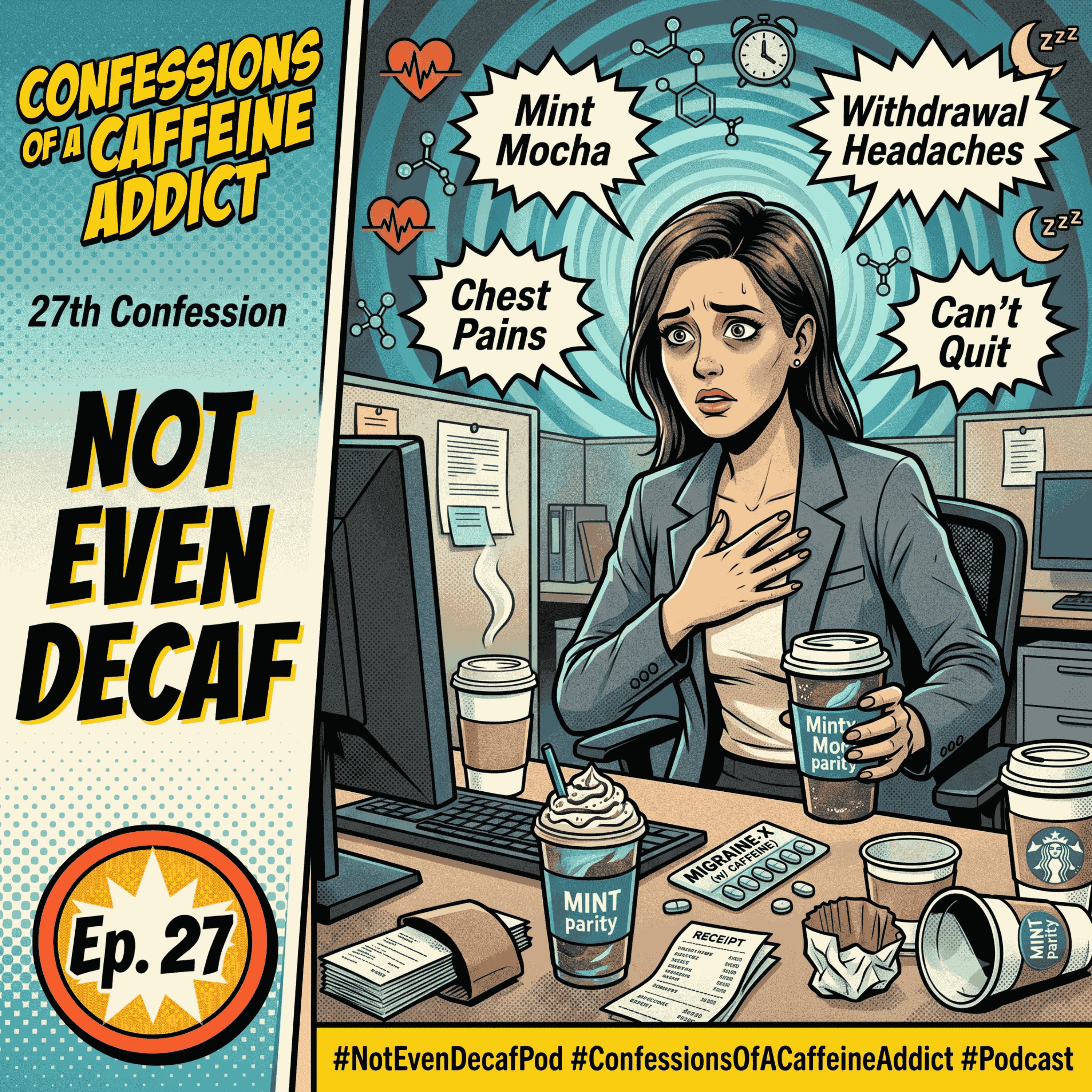
A simple vanilla steamer order turned into a full-blown Starbucks addiction after one sip of a co-worker's mint mocha, eventually triggering heart palpitations and a terrifying diagnosis scare at just 28 years old. "Not Even Decaf" follows an unassuming caffeine newcomer who never drank coffee or dark soda, only to spiral into multiple daily mochas, weight loss, insomnia, and chest pain within months. It's a candid account of how quickly caffeine can take hold even for someone who actively avoided it for years.
What You'll Hear in This Episode
- How years of ordering warm vanilla steamers at Starbucks ended the moment a co-worker offered a taste of his mint mocha.
- The rapid escalation from one afternoon mocha to multiple daily visits at both Starbucks and Caribou Coffee.
- Unexplained weight loss and appetite suppression masked a growing physical dependency on caffeine.
- A terrifying night of chest pain, a racing heart, and breathing difficulty that finally prompted a doctor's appointment.
- The blunt diagnosis from a doctor's receptionist, and later the doctor himself, pointed directly to caffeine as the cause.
- The awkward but honest confession to a co-worker about being "hooked on caffeine" and the discovery that hidden sources like Tylenol for Migraines contained caffeine too.
- The successful return to Starbucks ordering only a vanilla steamer proved recovery was possible without becoming a social outcast.
Key Takeaways
- Caffeine dependency can develop quickly, even in people who previously avoided coffee and dark soda entirely.
- Physical symptoms like chest pain, irregular heartbeat, and insomnia can be early warning signs of excessive caffeine intake.
- Hidden caffeine sources, including over-the-counter headache medications, can undermine quit attempts without people realizing it.
- Medical professionals may recognize caffeine-related symptoms faster than the person experiencing them.
- Successful recovery doesn't require giving up social coffee shop visits entirely, just choosing caffeine-free options.
Who Should Listen
- Anyone who has suddenly developed a new caffeine habit later in life after previously avoiding it.
- Listeners experiencing unexplained heart palpitations, chest pain, or sleep disturbances tied to daily habits.
- Individuals are unaware that common medications like migraine relievers often contain hidden caffeine.
- Anyone worried that quitting caffeine means giving up their favorite coffee shop routine entirely.
Resources & Links
🌐 Visit us at https://linktr.ee/UnwiredLife
📖 Confessions of a Caffeine Addict by Marina Kushner
📩 Share your own caffeine confession: https://linktr.ee/UnwiredLife
🛒 Live Unwired Media : LiveUnwired.org
Transcript
By noon, I was sweating, and my heart was racing. I couldn't figure out why. I thought, it's probably just stress. It had been a busy morning, and it didn't occur to me that my first real brush with caffeine might be the cause. Sure, I'd had my share of sodas, usually 7-Up or ginger ale, but I'd avoided coffee and dark soda because I didn't want to yellow my teeth. Although coffee smells fantastic, I also always thought it was too bitter without about 6 tablespoons of sugar and 4 of those tiny cups of cream in it. Listen, we all talk about the grind, but most of you are subsidizing your hustle with a chemical loan you can't pay back. In this new series, Unwired, we aren't just talking theory. We're going into the dirt with 40 anonymous stories of people who thought they were using caffeine to be superheroes, only to realize it was the very thing dismantling their health and their marriages. This is the case study of the hidden tax on your ambition. This is the case study of how a fun coffee drink turned into a quiet addiction. Welcome back to Live Unwired. Real stories from real lives transformed by one everyday drug, most of us barely even question. This 27th confession is called Not Even Decaf. It starts with a woman in a big office building, always tagging along to Starbucks but ordering vanilla steamers— warm milk, no coffee, no caffeine. Then a coworker named Mario offers her a sip of his mint mocha. It's rich, sweet, and comforting. She orders her own, drains it on the 6-minute walk back upstairs, and soon the mint mocha becomes her morning ritual. Within weeks, she's craving a second cup in the afternoon, losing weight because mochas replace breakfast, and getting headaches and foul moods if she skips a day. She adds weekend trips to Caribou Coffee, knows the baristas by name, and starts having trouble sleeping. One night, she wakes with crushing chest pain, twitchy legs, and a racing heart. Her doctor asks about caffeine, and suggests cutting out coffee, warning that withdrawal will bring headaches, moodiness, and weight gain, and that resisting will be harder than she thinks. Walking past Starbucks the next morning, she forces herself to keep going. She eats her cereal bar for the first time in months and tells Mario she's hooked on caffeine and trying to quit. He suggests decaf. She Googles it, sees it still has caffeine, and decides she doesn't want to cheat. At a family party, a Mormon cousin explains that many over-the-counter medications also contain caffeine, including the Tylenol for migraines she's been using to kill withdrawal headaches. 3 weeks later, her blood pressure is lower, she's up 6 pounds, and she feels much better off caffeine, even if she doesn't confess the Tylenol detail to her doctor. Now she still goes to Starbucks, but orders vanilla steamers instead of mint mochas. Heart palpitations, restless legs, sleepless nights, and morning headaches, she's decided, aren't worth any drink. And when her now-boyfriend Mario offers a sip of his decaf mocha with mint, she asks for a kiss on the cheek instead. This episode is brought to you by Live Unwired, liveunwired.org, a community helping people reclaim natural energy, deeper sleep, and real peace of mind without leaning on stimulants. liveunwired.org is the home base for the show and the gateway to 3 core resources from the Adrenal Foundation: The Truth About Caffeine, The Truth About Coffee, and Confessions of a Caffeine Addict: 40 True Anonymous Stories That Inspired This Series. Together, these 3 books give you the science, the lived experience, and the practical insight you need if you're ready to explore life with less or no caffeine. And if you recognize yourself in the edges of this story, you'll find support waiting at liveandwired.org. Now settle in for Confession 27, Not Even Decaf. Not Even Decaf. It began innocently enough. I used to work in a large office building with a Starbucks on the ground level. I've always been, um, somewhat daunted by their lengthy and diverse menu of drinks, many of which I didn't even know how to pronounce, let alone attempt to custom order. So, when various coworkers would ask me to run downstairs with them for a coffee and some harmless gossip, I would always order the same innocent drink: a vanilla steamer. That's right, me, a grown-up, would order warm milk. I liked it. It tasted good. It helped calm my sometimes overwrought nerves, and it wasn't expensive. In my hundreds of trips to that Starbucks, I have never heard anyone else order steamed milk without coffee. Then one day, one of my coworkers, Mario, offered me a taste of his mocha with mint. Ooh, it smelled heavenly, and I really liked the guy, So I took a timid sip. It was delicious, rich and sweet. The pink-haired barista asked me if I wanted one, and I said yes. I ordered a medium size, gratefully accepted her offer of whipped cream, and ignoring the potential for third-degree burns on my tongue, gulped the whole piping hot drink down on the 6-minute walk back up to my office. I feared Mario would think I was uncouth, but I noticed he also tossed his empty cup into the trash bin outside our sleek glass office doors. By noon, I was sweating and my heart was racing. I couldn't figure out why. I thought it's probably just stress. It had been a busy morning, and it didn't occur to me that my first real brush with caffeine might be the cause. Sure, I'd had my share of sodas, usually 7-Up or ginger ale, but I'd avoided coffee and dark soda because I didn't want to yellow my teeth. Although coffee smells fantastic, I also always thought it was too bitter without about 6 tablespoons of sugar and 4 of those tiny cups of cream in it. The mint mochas from Starbucks were different and delicious. I found that most mornings I didn't even want my cereal bar after drinking a cup. It was that filling! I started losing a little weight, not realizing what I know now: most diet pills contain caffeine as an appetite suppressant. After a few weeks, I started craving a cup of mocha in the afternoon, too. If I didn't go downstairs to Starbucks and get one, my coworkers joked that I got cranky. I definitely needed the pick-me-up and assumed it was the chocolate syrup, the mint, the flavor, or perhaps the sugar— something that gave me that much-needed lift. Then I started drinking coffee on weekends. There wasn't a Starbucks in my neighborhood, but there was a Caribou Coffee, so I started going there on Saturday mornings and sometimes in the afternoons and on Sundays. Sundays too. I got to know baristas and who was the most generous with the whipped cream. They all learned my first name and would begin preparing my drink when I walked in before I even ordered it. I thought that was cool, in a cheers sort of way. I lost a few more pounds. I had trouble sleeping. If I skipped a cup of mocha for a day, I got horrible headaches and became a crabby, miserable wretch. Again, I chalked it all up to the stress at work. I never thought I might be addicted to the caffeine in my new drink of choice. Who had ever heard of it? Everyone I knew drank coffee nonstop and never had any complaints, and certainly no one seemed like an addict. One night I woke up from a crushing pain in my chest and could not breathe. My heart was racing. I used yoga breathing and gradually calmed down. As I tried to fall asleep again, I resolved to call my doctor in the morning and schedule an appointment. Heart problems run in my family, so I couldn't take any chances. By morning, I had forgotten about everything. I stopped at Starbucks on my way into the office and ordered my usual mocha with mint. I walked to the elevator bank with the warm, white cardboard cup in my hand, blissfully unaware that the reason for my recent health problems and mood swings had just cost me a little less than $6. By the time I reached my floor, the mocha was gone, and I was licking the last little flecks of whipped cream from the lid. I had another cup after lunch, and then I went downstairs to get one more, and then one more. Leaving the office, even for the short several minutes, always felt like a breeze, and I had a reason that was totally understood by everyone. When I returned to my desk and indulged in my mocha, I began to feel jittery and uncomfortable. I became like a bundle of nerves. My hands shook and I could not punch the right keys, and even touching the keys was getting on my nerves. My mind was running faster than my hands. I typed the following letters of the word faster than the forefront, the ending of the word faster than the beginning. I skipped letters and words. I could not type. I, I felt cranky and nauseous. I was in a cold sweat and had a chest pain. I left the office earlier, and on the way home, I stopped at Caribou for one more mocha. At night, I woke up from twitchy legs and a painful, frightening, irregular heartbeat. The next morning, I did remember to call my doctor. His receptionist scheduled the appointment for the following week. I told her that I had been having trouble sleeping and that when I finally did fall asleep, I would wake up sometimes from cramps in my legs and heart palpitations. I did not— Quick pause for a second. If you're hearing yourself in this book, I built 2 things to go deeper than this audiobook can. First, there's Unwired, a caffeine cessation app where you can track your own withdrawal timeline, sleep, mood, and crashes day by day. And inside Unwired, you can work one-on-one with a coach who actually understands caffeine addiction and will walk you through a real plan instead of you guessing alone. The waitlist link is at the very top of the description. Second, there's the Unwired podcast built around 40 real caffeine case studies. Students, parents, founders, night shift workers walking through the same crashes you're hearing about right now. The link is right next to the app. If you want more than information, if you actually want a plan, a coach, and stories that feel like yours, hit those links, then come right back. Tell her that I was afraid that it was a heart problem. I was too scared to say the words out loud. With a laugh, she said, honey, lay off the coffee. She sounded light, not serious. I did not think that she was giving me advice. When I walked into Starbucks later that morning, I paused. It had just occurred to me that these drinks might be causing some of my problems. I had heard growing up, like probably almost all children that wanted to try their dad's coffee, that caffeine might stunt new growth and that it made some people hyper. But I didn't really know anything else about it. Caffeine is not like nicotine or alcohol or Vicodin. It's not a drug. I thought I would ask the doctor about it next week. In the meantime, I ordered a smaller-sized cup of mocha, and soon I was craving another one, but I was too busy to run downstairs. By noon, I was hit with a blinding headache. I took 2 Tylenol for migraines and had a cup of mocha at lunch and felt much better. I stopped at Starbucks again on the way out for the day. I couldn't fall asleep until almost 3 o'clock in the morning. Then I woke up. My heart was racing. I woke up 2 more nights in a row before the doctor's appointment on Monday. By the time I arrived at his office, I was terrified but resigned. Certainly he would not tell me that I, at age 28, would need a pacemaker. Instead, he asked me about my work, about my dating life, my exercise and my diet, particularly about my alcohol and caffeine intake. I was surprised and said, I thought your receptionist was joking. No, he said with a calm smile. She might be right. He advised me to stay away from coffee for a couple of weeks to see if that helped and warned me that I might have some unpleasant side effects from my withdrawal: headaches, moodiness, nervousness, or gain a little weight. He made it sound as though it would be a struggle when he said, try your best not to give in, like I was going to try to quit smoking. I must have looked skeptical because he said, I'm serious, it may not be as easy as you think. Hmm. The next morning, I tried to hold my breath as I walked by Starbucks to avoid the tempting aroma. I ate my cereal bar for the first time in months, and when Mario stopped by my office door at 2 o'clock to see if I wanted a coffee, I declined. I tried not to think about coffee the next few days. My doctor had been right. This was not going to be easy. 3 days later, Mario asked what was going on, why I was hiding. Was I mad at him? Mario, I started, taking a deep breath, I'm hooked on coffee. Actually, on caffeine. I'm hooked on caffeine, and I'm trying to quit. It sounded crazy when I blurted it out like that. He looked at me as though I'd lost my mind. Is that why you don't want to go to Starbucks with me? he asked. I nodded sheepishly. You know, he said, they do make decaf mochas. Oh, silly me, I hadn't thought of that. When he walked away to get his mocha, I Googled the caffeine content in decaf coffee. Tempting, but it did still have caffeine in it, and I didn't want to cheat. I kept reading and discovered that one of my favorite things in the world, chocolate, also contains caffeine. Shoot! This really was going to be tough. At a family birthday party the next day, I told my cousin about my strange new addiction, but she didn't bat an and I. She's a Mormon, and she told me that Mormons avoid caffeine just like they avoid cigarettes and alcohol and everything else addictive. Look out, she advised. Many over-the-counter medications also contain caffeine. Like what? I asked, mystified. Well, like Tylenol for migraines, she said. Ah, that's why that stuff worked so well in getting rid of my headaches. My cousin continued on with her list of the strange places where caffeine pops up. They've moved on from caffeinated energy bars and drinks and now manufacture lip balms and sunflower seeds with caffeine. But by then I wasn't really listening. I was still annoyed that I had been cheating with my headache medicine without even knowing it. After 3 weeks, I went back to my doctor for a follow-up visit. My blood pressure was a little lower. I had gained 6 pounds. When he asked me about my sleep pattern, restless legs, and heart palpitations, I told him that I was feeling much better. When he asked me about my withdrawal process, he seemed impressed that I quit cold turkey. I did not tell him about the Tylenol. Great, he said. Now let's talk about your cholesterol. Ooh. Since I quit, I've gone back to Starbucks and have ordered my vanilla steamer. The pink-haired barista smiles as she makes it. She can smile as much as she wants, but I know that mint mochas are not worth having heart palpitations, sleepless nights, and morning headaches. In spite of my fervent avoidance of all caffeine-containing products, I haven't become a complete social outcast. When my now-boyfriend Mario offers me a sip of his own decaf mocha with mint, I give him a look and sweetly request a peck on the cheek instead. From vanilla steamers to mint mochas, from cute Starbucks rituals to chest pain and twitchy legs, her journey made one thing clear: addiction doesn't care how fancy the drink looks. Recognizing that decaf still contained caffeine and that Tylenol Migraine was quietly sabotaging her withdrawal took humility and curiosity she didn't expect to need. If you're in the phase of telling yourself, I've switched to decaf, so I'm fine, this confession is a gentle nudge to read labels and be honest about what your body is still getting. For more on hidden caffeine in medications, diet products, and everyday treats, and guidance on designing a cleaner withdrawal, visit liveunwired.org. If you made it this far into the truth about caffeine, you already know this isn't just about coffee. It's about your nervous system, your sleep, your anxiety, and your life. If you don't want to do this alone, that's why I built Unwired. Inside the Unwired app, you can log your last caffeine use, track withdrawals, sleep, mood, and energy over days and weeks. See your own nervous system reset instead of hoping it's working. And get matched with a coach for one-on-one training so you're not white-knuckling this by yourself. Alongside that, The Unwired podcast walks through 40 real caffeine case studies, people who went from just coffee to energy drinks and pills, and then back out. You'll hear their mistakes, relapses, and what actually worked. Both links are at the top of the description. Join the Unwired app waitlist for coaching and tracking. Listen to the Unwired podcast. Save this audiobook, send it to one person who needs it, and if you're stuck in that daily 2 PM crash, come do this with us inside Unwired, not just in your head.